
Appointment setting services put an outside calling team between your prospect list and your sales calendar. The callers phone business contacts, check whether they fit, and book a meeting with one of your reps. If you are weighing B2B appointment setting services for your own team, four decisions determine whether the arrangement works: how you pay, what counts as a meeting, which calling rules apply in the countries you dial, and how you test a provider before you commit.
What appointment setting services cover
In B2B appointment setting, callers work a list of accounts you have approved. They reach the right person, ask a few qualifying questions, and place a confirmed meeting on a rep's calendar with their notes attached. Some providers sell the qualifying step on its own as lead qualification services. In an appointment setting engagement it is part of every call.
Four different things appear under this label. Only the first is the subject here.
| What it is | What you get | In this guide |
|---|---|---|
| B2B appointment setting | People who call business prospects, qualify them and book sales meetings | Yes |
| Lead generation | A list and some sign of interest, produced through ads, content, email or events. You receive names, and someone still has to call them | As the input only |
| B2C booking and reminder calls | Calls to consumers to book, confirm or move a visit. Consumer calls bring extra rules, such as national do-not-call lists | No |
| Scheduling software | A booking link or calendar tool. The prospect picks a slot and nobody places a call | No |
If your gap is the list itself, start with how call centers run lead generation.
Appointment setting pricing: per appointment, retainer or dedicated seat
Appointment setting outsourcing is sold in three ways, and each one pays the provider for something different.
| Model | What you pay for | What it rewards | Who carries the risk |
|---|---|---|---|
| Per appointment (pay per meeting) | Each meeting that fits the agreed definition | Booking volume. A loose definition gets you more meetings and weaker ones | The provider pays for unproductive calling. You carry the risk of meetings your reps don't want |
| Monthly retainer | A campaign with an agreed scope of activity | Steady activity. Results only matter if you add targets | Mostly you |
| Dedicated seat, by the hour | A caller's hours, spent only on your campaign | Time on the phone. You direct the list, the script and the schedule | You carry the output risk, and you keep control and the data |
The dedicated seat is what many buyers mean by SDR outsourcing: a named caller who works as part of your sales development team. A separate guide covers what you control with a dedicated agent. In telesales outsourcing, the caller closes the sale on the phone and no rep takes a meeting.
What a dedicated seat costs per month
The arithmetic is short:
Monthly cost = hourly rate × hours per week × 52 ÷ 12
Callnovo's dedicated seats can take on B2B appointment setting calls: phoning business contacts, qualifying them and booking sales meetings. The published rate for a dedicated English-speaking agent is from US$5.80 for each agent hour. That price page lists the scope as weekday daytime phone answering in English, so the rate and scope for an outbound appointment setting project are set in the quote. Engagements run from half a seat to 200+ seats.
Here is the formula at the published starting rate, with weekly hours as example assumptions:
| Example | Calculation | Monthly cost |
|---|---|---|
| Half a seat, for example 20 hours a week | 5.80 × 20 × 52 ÷ 12 | about US$503 |
| One seat, for example 40 hours a week | 5.80 × 40 × 52 ÷ 12 | about US$1,005 |
Ask for the quote to state paid hours, training, supervision, absence cover and any extra shifts.
The in-house comparison
For a US hire, the Bureau of Labor Statistics publishes hourly wages by occupation. These are its May 2025 figures (BLS, 2025):
| Occupation (SOC code) | Mean | Median |
|---|---|---|
| Telemarketers (41-9041) | US$17.97 | US$17.04 |
| Sales Representatives of Services, Except Advertising, Insurance, Financial Services, and Travel (41-3091) | US$39.63 | US$33.65 |
| Sales Representatives, Wholesale and Manufacturing, Except Technical and Scientific Products (41-4012) | US$39.68 | US$34.65 |
The two sales occupations cover full-cycle selling, so treat them as the upper reference for a caller who only books meetings.
Wages are only part of the cost. In the BLS Employer Costs for Employee Compensation release for June 2026, wages made up 75.3% of employer cost for sales and related occupations, and benefits made up 24.7% (BLS, 2026).
As an illustration, if a telemarketer's benefits took the same share, a US$17.97 wage would mean about US$23.86 per hour worked in total compensation. Recruiting, training, a manager's time, and dialing and data tools come on top.
Compare outsourced appointment setting with an in-house hire on that basis: the full hourly cost of each option, for the same weekly hours.
Define a qualified meeting, even when you pay by the hour
Under per-appointment pricing, the definition of a qualified meeting is the billing unit, so both sides negotiate it. Under hourly pricing nobody is billed by it, and it often goes unwritten. Write it into the statement of work anyway, as the acceptance measure.
When you compare appointment setting companies, give each one the same terms, the way a call center outsourcing RFP does. An appointment setting agency that bills by the hour should still report against them.
| Term | What to write down |
|---|---|
| Account and contact criteria | Industry, company size and region. The job titles that count. Accounts to exclude, such as current customers and open opportunities |
| Informed agreement | The prospect knows which company the meeting is with and what it is about, and has accepted a calendar invitation for a specific time |
| Show check | A meeting counts as held when your rep and the prospect both attend. State how a reschedule is counted and who records attendance |
| Handoff fields | What the caller enters in your CRM: contact name and direct number, answers to the qualifying questions, call notes, plus the recording link |
| Meetings that don't qualify | Wrong title, outside the criteria, or a no-show that was never rebooked. These are reported separately with the reason |
| Data and recordings | Lists, call records, recordings and CRM notes belong to you and are returned when the engagement ends |
Calling rules for B2B appointment setting in the US, Canada and the UK
Before any cold calling starts, check the rules for each country on your list. In the US and Canada, a call to a business is exempt from several rules written for consumer calls, though not from all of them. In the UK, the regulator applies the same rules to live calls to businesses and to individuals. The table summarizes the rule texts.
| Country | Rule | What it means for B2B calls | What to put in the contract |
|---|---|---|---|
| US | Telemarketing Sales Rule (FTC) | Most calls to a business are exempt. The bans on misrepresentation and on false or misleading statements still apply | Approved script and claims. Call recording |
| US | TCPA rules (FCC) | Autodialed, prerecorded or artificial-voice calls to a mobile number need prior express consent. The text does not carve out business recipients | Dialing method stated in writing. How mobile numbers are identified and handled |
| Canada | National DNCL and Telemarketing Rules (CRTC) | The national list does not apply to calls to businesses. The Telemarketing Rules still do | Internal do-not-call list, calling hours, caller identification |
| UK | PECR, as explained by the ICO | Screen the list against the TPS and the CTPS and your own do-not-call list before live calls | Screening before each campaign. Number displayed on every call |
United States
The Telemarketing Sales Rule exempts "telephone calls between a telemarketer and any business to induce the purchase of goods or services". Two things fall outside that exemption:
- The requirements of § 310.3(a)(2) and (a)(4), which bar misrepresenting material information in a sale and making a false or misleading statement to induce payment.
- Calls selling nondurable office or cleaning supplies.
The FTC's 2024 amendments, effective May 16, 2024, are what extended those two prohibitions to B2B calls. Every claim in the calling script has to be one you can stand behind.
The FTC's compliance guide states that the rule's ban on calling numbers on the National Do Not Call Registry "does not apply to business-to-business calls." The same guide describes the rule's time-of-day limit, 8 a.m. to 9 p.m., as applying to calls to a person's home.
Mobile numbers need separate attention. Under 47 CFR 64.1200, no one may call a number assigned to a cellular service using an automatic telephone dialing system or an artificial or prerecorded voice without the called party's prior express consent. A telemarketing call made that way needs prior express written consent. The condition is the type of number and the way it is dialed, with no distinction for a business recipient.
Two rulings define the terms:
- The FCC confirmed in 2024 that AI-generated voices count as artificial voice under these restrictions.
- In Facebook v. Duguid, the Supreme Court held that an automatic telephone dialing system must be able to store or produce a number "using a random or sequential number generator."
The do-not-call and calling-hour provisions in the same section are written for residential telephone subscribers. The answer turns on your dialing method and on whether a number is a business line or a personal mobile, so have counsel review both before the first campaign.
One date to know: an FCC rule on revoking consent takes effect November 25, 2026. It governs consent given for robocalls and robotexts and does not address calls a person dials one at a time.
Caller ID authentication sits with the carriers. FCC rules required voice service providers to implement the STIR/SHAKEN framework in their IP networks. A December 2025 FCC staff report notes that attestation results and other call information feed the analytics engines "which providers use to make call blocking and labeling decisions."
Canada
Canada's National Do Not Call List rules do not apply to telemarketing calls made to businesses. The exemption stops there. The CRTC's Unsolicited Telecommunications Rules state that the Telemarketing Rules "apply whether or not the telemarketing telecommunication is exempt from the National DNCL Rules." Three of them shape a campaign:
- Internal do-not-call list. A telemarketer must add a name and number to its own list within 14 days of a do-not-call request and keep it there for "three (3) years and fourteen (14) days."
- Calling hours. Calls are restricted to 9:00 a.m. to 9:30 p.m. on weekdays and 10:00 a.m. to 6:00 p.m. on weekends, in the time zone of the person receiving the call.
- Identification. The caller must identify the person or organization on whose behalf the call is made.
United Kingdom
The Information Commissioner's Office (ICO) says in its telephone marketing guidance that the rules for live marketing calls to businesses "are the same as for calls to individuals." Before live B2B calls, you screen the list against both the Telephone Preference Service (TPS) and the Corporate Telephone Preference Service (CTPS), and against your own do-not-call list. Callers must say who is calling and allow a number to be displayed.
Two points in the ICO's B2B marketing guidance matter for list building. Sole traders and certain types of partnerships are classed as individual subscribers and treated the same as individuals. The UK GDPR still applies to B2B marketing when you process personal data. The ICO has marked both pages as under review following the Data (Use and Access) Act, so read the current text before a UK campaign starts.
Time zones, languages and caller ID
In outbound sales outsourcing, the first scheduling decision is the call window, and it is set by the prospect's clock.
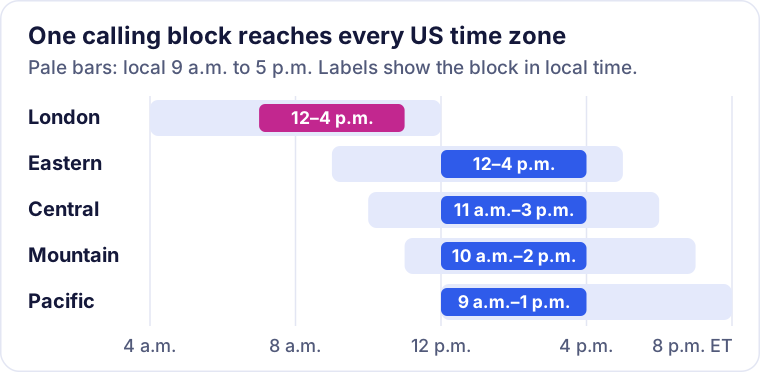
Example calling blocks. London is shown at five hours ahead of New York.
Time zones. Business hours of 9 a.m. to 5 p.m. across the four continental US time zones run from 9:00 a.m. to 8:00 p.m. Eastern, which is 11 hours. One eight-hour shift cannot cover that, yet a short block can reach every zone. As an example, 12:00 to 4:00 p.m. Eastern is 9:00 a.m. to 1:00 p.m. Pacific.
London is five hours ahead of New York for most of the year, so UK business hours end at noon Eastern, and UK prospects usually need their own morning block.
Callnovo ran a recall campaign for two optical retail stores, in which agents phoned existing customers about returning for a check-up. The team called four hours a day instead of a full eight-hour shift, because early and late calls would have disturbed people. That was consumer calling, and business prospects keep different hours. The method carries over: start from when the person can take a call.
Languages. If your buyers work in Spanish, German or Japanese, a native-speaking caller should make the call. Callnovo staffs human agents in 65+ languages, including Spanish-speaking agents. Sales support outsourcing around the calls, such as CRM updates, day-before confirmations and rescheduling, should run in the same language and the same hours as the calling. See also how an outbound call center personalizes each contact and how inbound and outbound services differ.
Caller ID. A prospect who sees a company name is more likely to know who is calling. CNAM registration, offered by HeroDash, the contact center platform Callnovo uses, ties a US number to your brand name for display. Know its limits before you count on it:
- It supports US numbers, both local and toll-free. International numbers are not supported.
- It does not remove a spam label. Labels depend on call frequency, calling patterns, complaints and carrier risk controls.
- It does not guarantee a connection. Whether someone answers still depends on the time of the call, the number's reputation and the person's own choice.
A 30-day pilot scorecard
A pilot on a dedicated seat should show each stage between a dial and a meeting your rep accepted. Agree on the table before the first call and review it weekly.
| Stage | Who records it | Evidence to look at |
|---|---|---|
| Dialed | Provider | Dialer or phone-system log, by day and time zone |
| Connected | Provider | Call log with duration. Listen to a sample |
| Conversation with the right contact | Provider, checked by you | Recording and CRM note showing title and the qualifying answers |
| Meeting booked | Provider | Accepted calendar invitation |
| Meeting held | Your rep | Attendance marked in the CRM after the meeting |
| Accepted by sales | Your sales manager | A yes or no against the written definition, with the reason for each no |
Each week, read the stages in order and find where the count drops. For the conversation stage, score a sample of recorded calls against the same criteria. A low connection count points to the list or the call window. Conversations that don't turn into bookings point to the script or the criteria. Booked meetings that sales rejects point back to the definition. Adjust only one of them each week.
To start, bring three things: your account and contact criteria, a sample of the list, and your qualified-meeting definition. With those, a pilot can begin at half a seat. Send them to the Callnovo team for a quote on the scope.
FAQ
Can an offshore team set appointments for a US sales team?
Yes. The conditions are the ones a domestic team faces: callers work the prospect's business hours, speak the prospect's language, and show a caller ID the prospect can recognize. The time-of-day rules in the US and Canadian texts are written in the called party's local time, so the schedule follows the prospect's location, wherever the callers sit.
Can an AI voice make the first call instead of a person?
The FCC confirmed in February 2024 that voices generated by AI fall under the TCPA's restrictions on artificial or prerecorded voice. A caller needs the called party's prior express consent before placing such a call, and FCC rules require that consent in writing when the call is telemarketing to a mobile number. A cold list does not come with that consent, which is why a person should place the first call.
What should we give the provider before the first call?
Five things: the account and contact criteria, a sample of the list with direct numbers where you have them, your internal do-not-call list and current customers to suppress, the qualified-meeting definition, and access to the calendar and CRM fields the callers will fill in.
References
- 16 CFR 310.6, Telemarketing Sales Rule exemptions
- 16 CFR 310.3, deceptive telemarketing acts or practices
- FTC, Telemarketing Sales Rule final rule, 89 FR 26760 (April 16, 2024)
- FTC, Complying with the Telemarketing Sales Rule
- 47 CFR 64.1200, delivery restrictions
- Facebook, Inc. v. Duguid, No. 19-511 (April 1, 2021)
- FCC Declaratory Ruling FCC 24-17 on AI-generated voices (February 8, 2024)
- FCC final rule on revocation of consent, 91 FR 67214 (October 26, 2026)
- 47 CFR 64.6301, caller ID authentication
- FCC Wireline Competition Bureau, STIR/SHAKEN report (December 19, 2025)
- Canada National Do Not Call List, exemptions
- CRTC Unsolicited Telecommunications Rules
- ICO, telephone marketing
- ICO, business-to-business marketing
- BLS Occupational Employment and Wage Statistics
- BLS Employer Costs for Employee Compensation, June 2026