
Bolivia call center outsourcing can help a US business add English and Spanish customer support during overlapping working hours. To decide whether it fits your team, check the actual agents, shift schedule and handling of customer requests—not just the country or an advertised hourly rate.
This guide walks through the decisions that matter before you sign: when a Bolivia team is useful, how daylight saving changes the schedule, what to test in a language assessment, and how to compare quotes and run a small pilot.

When does a Bolivia call center make sense?
Start with the work you want someone else to handle. You might need agents to answer order questions, troubleshoot a product, respond to Spanish-speaking customers or keep a support queue moving while your US team handles specialist requests. A nearby time zone is useful when those agents need to reach your warehouse, product team or account managers during the same working day.
Write down the problems you are trying to fix. “Answer English and Spanish delivery questions from 9am to 5pm Eastern” is a workable brief. “Improve customer experience” leaves too much open: the provider cannot tell which languages, hours, skills or staffing you need.
Bolivia may be less suitable for a particular queue if the proposed team cannot demonstrate the required language level, specialist knowledge or approved system access. A provider’s location does not prove those capabilities. Ask to meet the people who would handle your work and see them complete representative tasks.
If you are comparing outsourcing companies in Bolivia, check that each shortlisted company actually provides customer support. Software development, accounting and payroll outsourcing involve different teams and processes. Compare contact-center proposals against other contact-center proposals.
Match the shift to your US customers
Bolivia uses one time zone and does not change its clocks for daylight saving. The US State Department’s Bolivia information notes that Bolivia is one hour ahead of Washington, DC during Eastern Standard Time. During Eastern Daylight Time, the clocks match.
The table below converts a 9am–5pm customer-service window into Bolivia time. It applies to US locations that observe the named daylight or standard time. Check the actual customer location when it follows different clock rules.
| Customer time zone | During US daylight time | During US standard time |
|---|---|---|
| Eastern | 9am–5pm Bolivia | 10am–6pm Bolivia |
| Central | 10am–6pm Bolivia | 11am–7pm Bolivia |
| Pacific | Noon–8pm Bolivia | 1pm–9pm Bolivia |
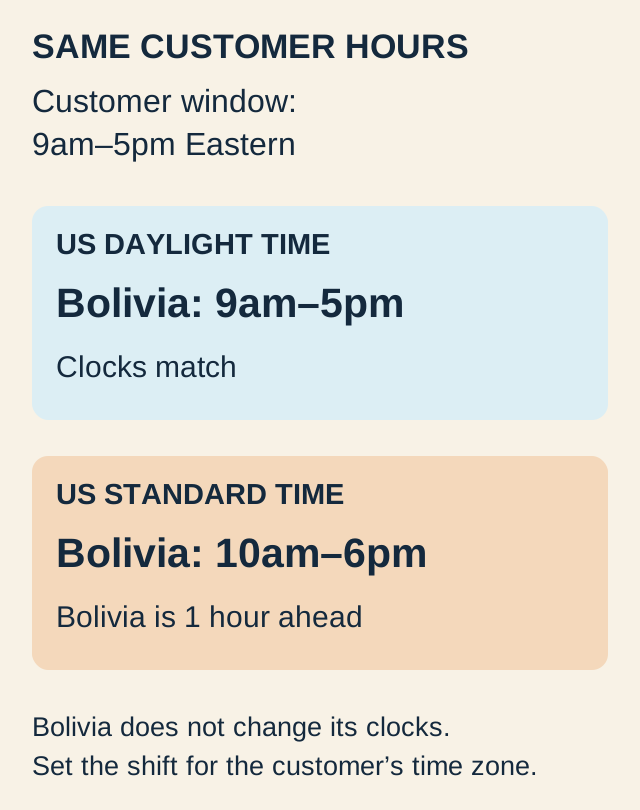
Put both time zones in the proposal. Agree who updates the roster when US clocks change, which holidays apply, and who covers breaks and absences. If your US office closes before the Bolivia shift ends, name someone who can receive urgent escalations during that gap.
Test the language skills your calls actually need
Do not use a national English-proficiency claim as a substitute for an agent assessment. The International Trade Administration’s Bolivia guide describes Spanish as the preferred business language, while noting that some businesspeople speak English. Your project still needs its own hiring and quality checks.
Give the proposed agents a small set of anonymized customer situations. Include a straightforward question, an upset customer and a problem that needs clarification. For each language you need, ask for a short call role-play and a written follow-up.
- Understanding: Can the agent accurately restate the issue and ask a useful follow-up question?
- Product knowledge: Can they find the right model, part or policy in your materials?
- Clarity: Can the customer understand what happens next without reading a long explanation twice?
- Judgment within the rules: Does the agent recognize when a refund, replacement or technical decision needs approval?
Use the same examples and scoring criteria for every provider. Review the proposed team’s work, rather than relying only on a sales demonstration by someone who will not handle your queue. Repeat the checks when replacement agents join.
Compare the full cost of the same workload
A useful quote starts with expected contacts, handling time, channels and service hours. Give each provider the same brief. Otherwise, a low hourly rate may cover fewer tasks, shorter hours or less supervision than another proposal.
Ask the provider to separate the recurring service charge from setup work and variable charges. Use this checklist when reviewing the proposal:
- Number of agents or seats, scheduled hours and the definition of a billable hour.
- Language requirements, product training, coaching and quality review.
- Team supervision, absence cover, holiday work and extra shifts.
- Phone numbers, carrier minutes, software licenses and system integrations.
- Minimum commitment, volume limits, overage rates and notice terms.
For example, a quote for one agent’s scheduled hours cannot be compared directly with a shared monthly phone package. Ask how many contacts the team is expected to handle and what happens when several customers call at once. Keep your own management and training time in the comparison too.
For Callnovo’s published service models, see the customer service outsourcing pricing page. Those reference packages are not a Bolivia-specific staffing quote. Send the actual language, coverage and technical requirements to get a scope you can compare.
Check the site, systems and escalation plan
Ask for a walkthrough of the proposed delivery setup and a demonstration of how work continues during an interruption. Useful evidence includes tested backup connectivity, power arrangements, a contact tree and a record of the latest continuity exercise. Ask who makes the decision to move work and how your team is notified.
The International Trade Administration’s market guidance identifies connectivity limitations and road blockages among Bolivia’s business challenges. That does not tell you how a specific center performs. It gives you a reason to check the actual site, staff-access arrangements and backup plan rather than accept a general claim about reliable infrastructure.
Set up access before live customer work starts. Agents should have named accounts and only the permissions needed for their tasks. Decide what can be downloaded, who can view recordings and how access is removed when someone leaves the project. The FTC’s business guidance recommends limiting access to necessary information and reviewing the practices of service providers.
Finally, test an escalation from start to finish. Give the team a request it cannot resolve, check where it goes and confirm that the receiving person has enough context to act. A ticket marked “escalated” is not finished if nobody owns the next step.
What a cross-border handoff looks like
Imagine a US customer contacts the Bolivia team about a product that will not start. The agent checks the model and follows the approved troubleshooting steps. If the problem remains, the agent records the symptoms, steps tried and relevant photo or error message, then sends the case to the person authorized to make the next decision. The customer receives a clear explanation of the follow-up, without an unapproved replacement promise.
The same record should stay with the request when it moves between languages or teams. With HeroDash internal notes, agents can keep supporting details with the conversation and mention the colleague who needs to respond. Internal notes stay separate from customer replies. Agree system access and the responsible roles before using that workflow.
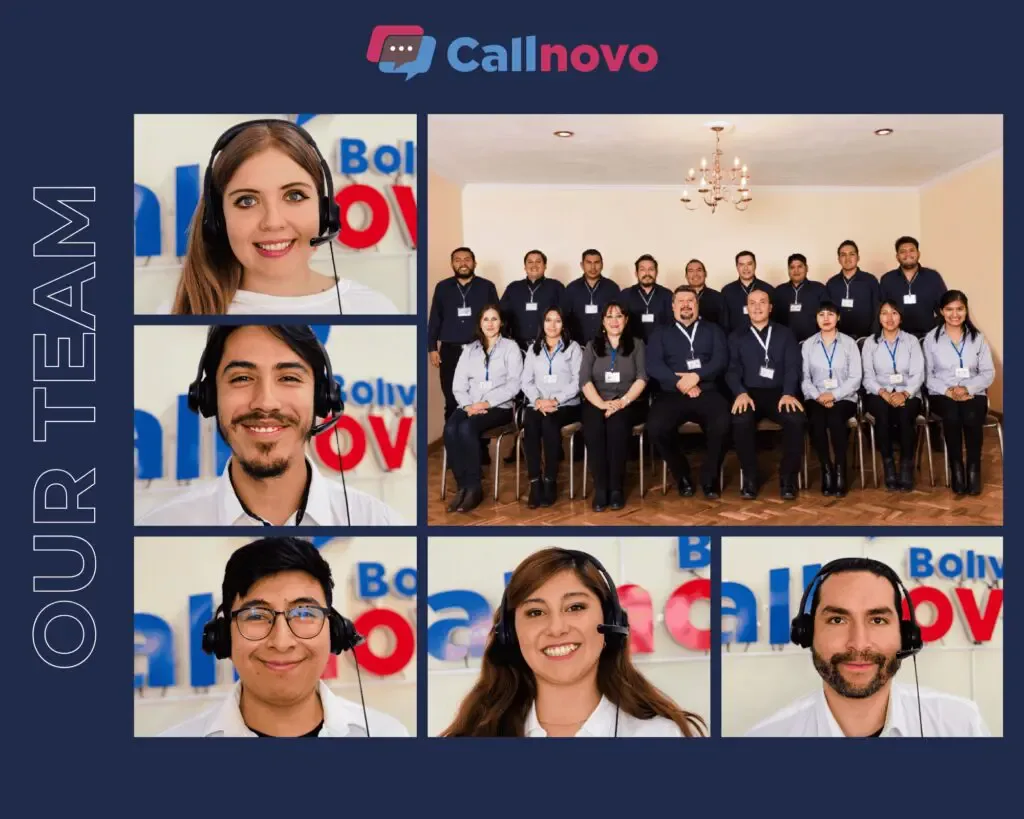
Callnovo’s July 2021 profile of colleague Vince Lupe gives a real example of coordination work from Bolivia. It describes him organizing client meetings, supporting Chinese account managers and working with daily and weekly project targets after moving into project operations. The account says he moved to Bolivia in winter 2017. This is a historical team story; the people and roles assigned to a new project should be confirmed in its proposal.
You can also watch the historical TP-Link customer testimonial included with the earlier article. Use references as a starting point for your questions, then ask how the proposed service would handle your own products and customers.
Run a small pilot before expanding
Choose a queue with clear tasks and enough real work to evaluate the service. For example, start with order-status questions in a defined language and service window. Keep unusual refunds or complex technical decisions with your existing team until the handoff is working.
- Agree the starting point. Record current response times, unresolved work and recurring errors. Define what success means for this queue.
- Prepare the team. Supply product materials, approved answers and escalation rules. Test access and practice common and difficult cases before live work.
- Review real conversations together. Check accuracy, tone, complete notes, follow-up and adherence to approval limits. Include a sample of unresolved cases, not only successful ones.
- Decide whether to expand. Add hours, channels or tasks only when the agreed quality checks are met. If something is failing, identify whether the cause is training, access, workload or unclear policy, then test the fix.
Set the pilot length and review frequency around the volume you expect. A quiet queue may need longer to produce a useful sample. Record the acceptance criteria before the pilot starts so both teams know what evidence will support the next step.
Questions buyers ask about outsourcing to Bolivia
Is Bolivia in the same time zone as the US?
It matches US Eastern Daylight Time and is one hour ahead of Eastern Standard Time. Other US time zones have different offsets. Put the customer’s local hours and the corresponding Bolivia shift in the schedule.
Can a Bolivia team support English and Spanish customers?
A provider can propose agents for those languages, but you should assess the specific people and tasks. Test calls and written replies in both languages, including product terms and difficult customer situations.
How much can outsourcing to Bolivia save?
There is no single savings percentage that applies to every project. Compare proposals for the same hours, workload, languages and quality requirements, including setup, supervision, tools and your internal management time.
Can I start with a small team?
Ask the provider to quote the minimum arrangement for your workload. Callnovo can discuss a phased scope; staffing, start dates and coverage need to be agreed for the project.
Ready to compare a Bolivia support option? Send your customer languages, service window, contact volumes and a few representative tasks. Request a Callnovo proposal that spells out the team, tools, responsibilities and pilot requirements.