
Latin America call center outsourcing means hiring a provider whose agents work from a Latin American country to answer your customers' calls, following your processes during your business hours.
For a US support team, that means two choices: the country that fits your callers' language and hours, and the provider whose agents meet your bar. Below, the main countries are compared on clock, English and local pay, followed by the questions to ask before you sign.
What a Latin America call center gives a US support team
Latin America outsourcing covers a lot of ground, from software development to accounting. The focus here is narrower: outsourcing in Latin America for customer support, where agents in the region answer calls, chats and emails from your US customers.
When US companies look at outsourcing to Latin America (LatAm) for support, four things usually draw them:
- Daytime hours. Most hubs sit between UTC-6 and UTC-3, so a 9-to-5 Eastern shift is a day shift for the agents, not a night shift.
- Spanish. It is the first language in every country below except Brazil, where it is Portuguese. That helps if many of your customers speak Spanish.
- English. It is available, but its depth varies a lot by country. The next section compares it.
- Distance. Short flights make site visits practical during training and launch.
Latin America is the main nearshore option for US companies: close enough that the time difference stays small. The usual offshore alternative, Asia, covers the US night instead, because the US night is daytime there.
Before you outsource to the region, check what it cannot cover. If most of your calls arrive overnight US time, if you need Asian or European languages, or if a contract or regulation requires US-based agents, a Latin American team solves only part of the problem.
Overnight hours still need a second region or a separately priced night shift. Our nearshore vs onshore and offshore comparison sets the three side by side.
Latin America call center countries compared
Call centers in Latin America are spread across Mexico, Central America, the Caribbean and South America. Across the region the time zone gap with the US East Coast is small, so countries mainly differ on English and local labor cost. The table compares them on both, plus the clock.
| Country | Main language | Clock vs US Eastern (winter / summer) | EF EPI 2026 score | Local pay level (ILO, 2025) | Often suits |
|---|---|---|---|---|---|
| Mexico | Spanish | 1 hour behind / 2 hours behind (Mexico City) | 431 | Middle | Spanish-first lines and large teams |
| Guatemala | Spanish | 1 hour behind / 2 hours behind | 498 | Middle | Spanish and bilingual lines on Central time |
| Honduras | Spanish | 1 hour behind / 2 hours behind | 554 | Middle | Bilingual lines on Central time |
| El Salvador | Spanish | 1 hour behind / 2 hours behind | 502 | Middle | Bilingual lines on Central time |
| Nicaragua | Spanish | 1 hour behind / 2 hours behind | 512 | No 2025 data | Spanish and bilingual lines on Central time |
| Costa Rica | Spanish | 1 hour behind / 2 hours behind | 488 | Higher | Bilingual lines where higher pay fits the budget |
| Dominican Republic | Spanish | 1 hour ahead / same time | 500 | Lower | Bilingual lines on Eastern time |
| Colombia | Spanish | Same time / 1 hour behind | 481 | Lower | Spanish and bilingual lines on Eastern or Central time |
| Bolivia | Spanish | 1 hour ahead / same time | 522 | Lower | Small English–Spanish teams on Eastern time |
| Brazil | Portuguese | 2 hours ahead / 1 hour ahead (São Paulo) | 469 | Lower | Portuguese lines |
| Argentina | Spanish | 2 hours ahead / 1 hour ahead | 563 | Higher | English-heavy lines that can start early Eastern time |
Pay levels use ILO average monthly earnings for clerical support workers in 2025: lower is under US$500, middle is about US$600 to US$700, and higher is about US$960 to US$1,040 (exact figures in the cost section below).
Use the English column to rank countries, then check the people. EF's score comes from the test results of adults who took its English test in each country (EF EPI, 2026). The agents you get depend on whom a provider hires and how it tests them.
A low national score does not stop a provider from hiring skilled bilingual agents in that country; it usually means a smaller pool to hire from. Ask every shortlisted provider for test calls on your real call types.
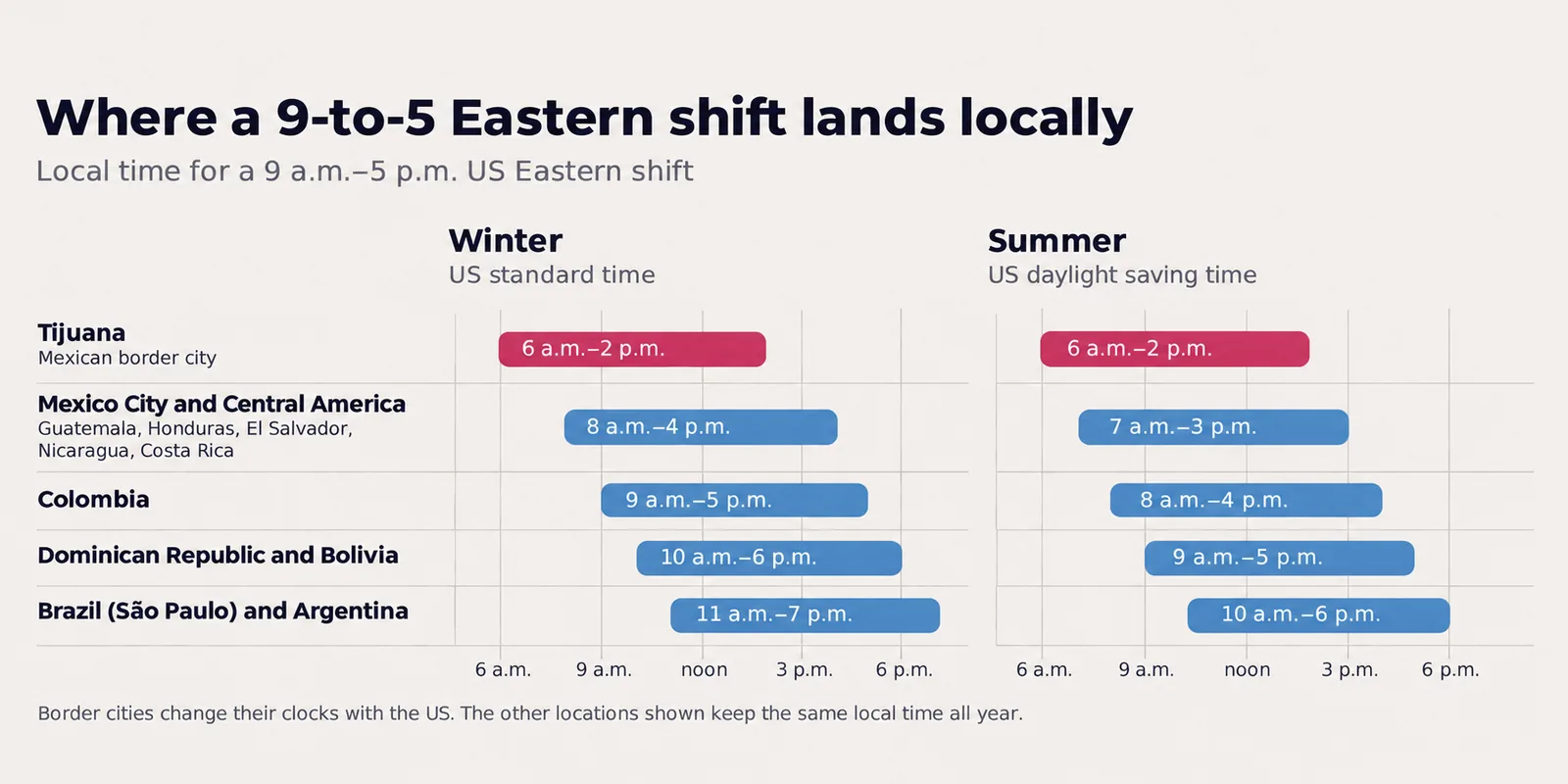
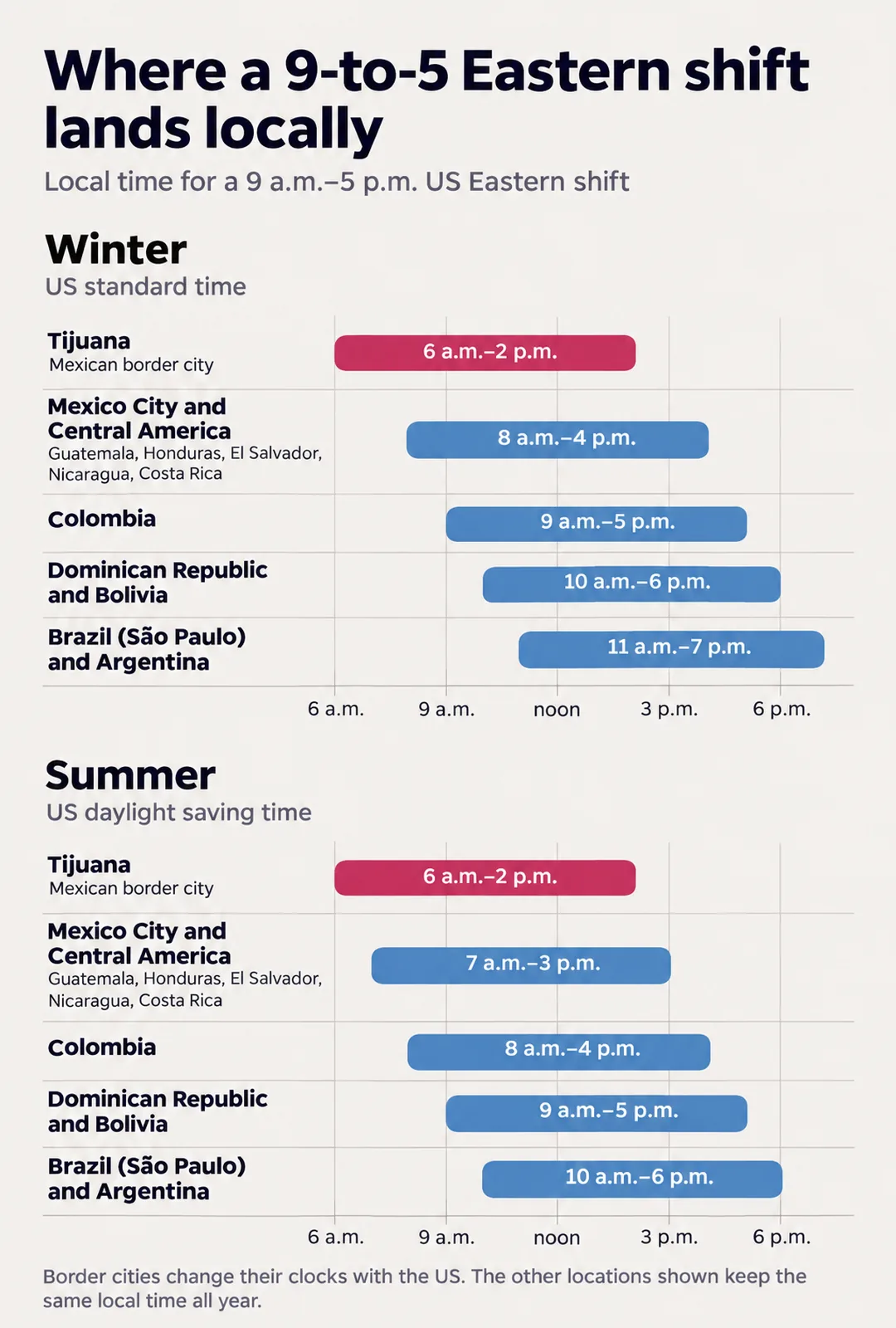
Read the clock column with daylight saving time in mind. None of these countries changes its clocks, so when the US moves its clocks in March and November, the gap shifts by an hour. Mexico's northern border cities are the exception, covered below. If your customers span several US time zones, check each one against the team's hours.
So which is the top country for outsourcing? There is no single winner. Pick the country whose language mix and clock match your callers, then let test calls decide between providers.
Three shortlists US teams usually weigh
From that table, three groups tend to make US shortlists: Mexico, for scale and proximity; Colombia, Central America and the Dominican Republic, for Eastern or Central hours; and Bolivia, for stronger English in a smaller market. Each section covers what the group suits and what to ask first.
Mexico call centers: scale, Spanish and the border clock
Call centers in Mexico are where many US companies start. Mexico borders the US, its call center industry is large, and many agents already serve Spanish-speaking customers in the US. A Mexico call center suits Spanish-first lines and teams that need to grow quickly.
Before you sign with a call center in Mexico, ask two things.
- The agents' English test results. Mexico scored 431 on EF EPI 2026, the lowest in the table. Agents with strong English work there too, but they are a smaller share of the pool. For English-first lines, judge on test calls rather than on the country.
- The city the agents work in. Under Mexico's 2022 time zone law, the country keeps standard time all year except along the northern border.
Border cities such as Tijuana, Ciudad Juárez, Reynosa, Matamoros and Nuevo Laredo still change their clocks with the US, on the second Sunday of March and the first Sunday of November. Tijuana keeps the same time as California all year. Mexico City, Guadalajara and Monterrey stay on standard time.
That means two teams that are both "in Mexico" can sit at different distances from Eastern time between March and November. Ask for the city before you build the schedule.
Colombia, Central America and the Dominican Republic
Here the differences are mostly about the clock. Colombia is on UTC-5 all year: the same time as New York in winter and as Chicago in summer. Guatemala, Honduras, El Salvador, Nicaragua and Costa Rica are on UTC-6, matching US Central time in winter and an hour behind it in summer.
The Dominican Republic is on UTC-4, matching New York in summer and one hour ahead of it in winter.
On EF EPI 2026, Honduras scored 554, Nicaragua 512, El Salvador 502, the Dominican Republic 500, Guatemala 498, Costa Rica 488 and Colombia 481. Pay differs more: clerical pay in Costa Rica is well above its neighbors in the ILO data (see the pay table below).
The question to ask first is where your Spanish-speaking customers are. Serving Spanish speakers in the US is a different job from serving customers in Latin America. Vocabulary, accents and expectations differ, so ask for agents who match your customer base.
Ask, too, whether one agent will take both English and Spanish calls or each language gets its own queue. If customers also write in on WhatsApp or chat, ask whether the same team covers those channels.
Callnovo's Spanish support runs from its centers in La Paz, Bolivia, and Managua, Nicaragua. For staffing a Spanish line, see our Spanish call center guide.
Bolivia: a smaller market with stronger English
Bolivia is a less familiar option for US buyers. Its English scores are strong for the region, and its call center market is smaller than Mexico's or Colombia's. Check four points:
- English. Bolivia scored 522 on EF EPI 2026, above Mexico (431), Brazil (469), Colombia (481), Costa Rica (488), Guatemala (498), the Dominican Republic (500), El Salvador (502) and Nicaragua (512), and below Argentina (563) and Honduras (554). The La Paz region scored 529. Test calls still matter, since this is an average too.
- Clock. Bolivia is on UTC-4 all year. During US daylight saving time it matches Eastern time; in winter it is one hour ahead, so a 9-to-5 Eastern shift runs from 10 a.m. to 6 p.m. locally.
- Scale. The market is smaller than Mexico's or Colombia's. It suits a team that starts with a few agents and grows, and suits less well a project that needs hundreds of bilingual agents at once. Ask any provider how many agents already work on similar projects there and how long hiring takes.
- A team already in operation. Callnovo's operating center in La Paz, at Torre Las Americas, is its nearshore base for the Americas.
One example of that team's work: in 2024, an EdTech SaaS platform brought in Callnovo's Bolivia team for second-tier technical tickets from its Spanish-speaking users across North America. For that account, the case reports a 28% drop in resolution times and a 21% rise in customer satisfaction (CSAT) scores.
Ask any provider in Bolivia for the same kind of evidence: a team that is running now, a project like yours, and the results it reported. Shift patterns, language testing and pilots are covered in our Bolivia call center outsourcing guide.
What country guides tend to leave out
Most problems with a Latin American team come from details nobody wrote into the contract, not from the country. A large call center industry does not guarantee people for your project either: global brands hire from the same pool of bilingual agents. Seven points to settle before you sign:
| Risk | What happens | What to agree |
|---|---|---|
| A national English average is not your agents | You choose on a country's reputation and get agents who struggle with your calls | Test calls on your real call types, scored against a level you set, such as a CEFR level (the European A1 to C2 scale) |
| Clock-change weeks | The US changes its clocks in March and November and most of the region does not, so shifts drift by an hour | Plan both weeks in the schedule; in Mexico, confirm the city first |
| US nights | A daytime team does not cover midnight to early morning Eastern | Price a night shift separately or use a second region |
| Currency and pay rules | Local wages and labor rules change, and a contract in local currency moves with the exchange rate | Bill in US dollars and write down how and when rates can change |
| Public holidays | Each country has its own holidays, which differ from US ones | Agree who covers local holidays and your US peak days |
| Office, network and power | Agents at home on a single connection are harder to supervise and keep online | Ask whether agents work from an office, and what backup internet and power the site has |
| Night, Sunday and holiday pay; US rules | Local labor law can add pay premiums for these shifts, and some US rules on where support is handled are under review | Ask how premiums are charged and who bears changes; regulated communications providers should check the FCC's pending onshoring proposal |
At Callnovo, 90%+ of agents are office-based rather than working from home. For how night coverage and the FCC proposal affect a nearshore plan, see our nearshore comparison.
What a Latin America call center costs
A quote from a Latin American provider can be priced per agent hour, as a monthly package, per minute or per contact. Whatever the unit, the rate covers more than pay: benefits required by local law, hiring, supervisors, the office, phone systems and the provider's margin.
Before comparing, ask every provider to quote in the same unit and to list what is included. Our pricing page shows Callnovo's rates by model.
What local pay tells you about the price
Local pay explains much of why quotes differ between countries. The ILO publishes average monthly earnings by occupation. The closest group to call center agents is clerical support workers, which includes contact center information clerks (ILO, 2025).
| Country | Average monthly earnings, clerical support workers, 2025 |
|---|---|
| Dominican Republic | US$410 |
| Bolivia | US$453 |
| Colombia | US$463 |
| Brazil | US$494 |
| Mexico | US$606 |
| El Salvador | US$615 |
| Honduras | US$639 |
| Guatemala | US$692 |
| Argentina | US$961 |
| Costa Rica | US$1,037 |
| United States | US$4,487 |
Nicaragua has no 2025 figure in this dataset. Keep two things in mind when reading the table.
First, these are employees' earnings, not outsourcing prices. A provider's rate also has to cover benefits, supervision, space, systems and margin, so subtracting a wage from a quote does not tell you what you save.
Second, the dollar figures are converted at official exchange rates. In Bolivia and Argentina the conversion moves the result a lot, so treat those two as a rough guide.
So which is the cheapest country in Latin America? On pay alone, the Dominican Republic, Bolivia and Colombia sit at the low end. The lowest wage does not always mean the lowest cost per resolved call, though: English depth, staff turnover and the management a team needs all change the result.
For an in-house comparison, US customer service representatives had a median wage of $21.53 per hour in BLS 2025 wage data, before benefits. Building your own center in Latin America means handling local employment, an office and hiring yourself. At low volume, outsourcing is usually the easier way to start.
Dedicated or shared agents, and how small you can start
| Dedicated agents | Shared agents | |
|---|---|---|
| Billing | Per agent hour | Monthly package or usage |
| Who answers | The same agents, at set hours, only on your account | A team that also answers for other clients |
| Suits | Steady calls that need product knowledge | Low volume, overflow or backup cover |
| What to ask | The minimum hours or seats and the notice period | How many clients share the team and what happens at peaks |
If your volume does not fill a full-time agent, ask each provider for its smallest billing unit before you compare prices.
Callnovo lists US$5.80 as the lowest hourly rate for English-speaking dedicated agents, Monday to Friday, 9–5 Eastern, with a minimum engagement of half a seat. Spanish and English–Spanish bilingual service are quoted per project. A shared English team costs from US$650 per month for those weekday hours.
Your quote also fixes the paid hours, the training and supervision, who covers absences, and any extra shifts. For more on picking between the two models, see shared or dedicated customer service.
How to choose a Latin America call center provider
Put these questions to every Latin America call center provider you shortlist. Each one goes back to a point above.
- Which country and city will the agents work in, and is the site the provider's own or subcontracted?
- How do you test English and Spanish, and can we hear test calls on our call types before we sign?
- Dedicated or shared agents, and what is the smallest unit you sell?
- How many agents does each supervisor manage, what is your attrition, and how fast is a leaver replaced?
- What share of calls does your quality team review, and how often do we get reports?
- What evidence of data security can you show, and which sites and systems does it cover?
- Can we start with a paid pilot?
Reviews and BPO directories help you build a longlist. Test calls and a paid pilot show you how a team handles your callers. For a full question list with a scoring sheet, see our call center outsourcing RFP guide.
For comparison, here is how Callnovo answers:
- Nearshore operating centers in La Paz, Bolivia, and Managua, Nicaragua.
- Dedicated agents for as little as half a seat or as many as 200+ on one client's account, plus shared teams.
- Leave cover, and free replacement when an agent is not the right fit.
- Delivery aligned with ISO 27001 and SOC 2 framework practices.
- 65+ languages handled by human agents, delivery from 26 countries, and local phone numbers in 120+ countries.
Callnovo has operated since 2004 and is headquartered in Toronto.
Before you request quotes
To make sure every provider prices the same work, prepare six things:
- The languages your customers speak, and where your Spanish-speaking customers are: which countries, or which US regions.
- The hours to cover in each US time zone, including clock-change weeks, weekends and holidays.
- Monthly volume for each channel, and your peaks.
- Dedicated or shared agents, and roughly how many agents or hours.
- The systems agents will use and the access each one needs.
- What a passing test call and a successful pilot look like.
Send them with your quote request, and Callnovo will quote dedicated agent hours or a shared package against them. Hiring a team of up to five agents takes about 3 business days, and training follows.
References
- International Labour Organization (ILO), ILOSTAT: Average monthly earnings of employees by sex, occupation and currency (clerical support workers, US dollars, 2025)
- EF Education First, EF English Proficiency Index 2026, country pages
- U.S. Bureau of Labor Statistics (BLS) 2025 wage data for Customer Service Representatives (43-4051), via O*NET OnLine
- Ley de los Husos Horarios en los Estados Unidos Mexicanos, published in Mexico's Diario Oficial de la Federación on October 28, 2022