

Call center burnout can leave an experienced agent exhausted, detached from the work and doubtful that their effort helps. A manager's response starts with a private conversation and a check of the conditions around the job: the queue, the schedule, difficult calls, broken tools and the authority to get help.
A rising handling time or an absence doesn't establish why someone is struggling. Use those changes to ask what has changed. Then agree on a practical work adjustment and someone responsible for carrying it out.
Call center burnout: what to do first
Start with the problem the agent describes. Separate the customer's unfinished request from the support the employee needs, so one doesn't disappear while the other is being addressed.
| What you notice | What to check first | Who should act |
|---|---|---|
| An agent describes persistent exhaustion | Workload, difficult-call exposure, overtime and access to breaks | Supervisor with scheduling support |
| More repeat contacts or longer calls | Case complexity, product changes, tool failures and available authority | QA lead and operations owner |
| A customer attacks the agent personally | Your escalation policy, immediate support and who can accept the interaction | On-duty supervisor or designated backup |
| Work is repeatedly left unresolved at shift change | Pending actions, promised updates and acceptance by the next owner | Outgoing and incoming supervisors |
A well-written policy needs enough coverage to operate. If every supervisor is in another meeting when an agent asks for help, the escalation route still needs work.
What call center burnout means
The World Health Organization's ICD-11 explanation describes burnout as an occupational phenomenon associated with unmanaged chronic workplace stress. Its three dimensions concern exhaustion, greater distance or cynicism toward the job, and reduced professional efficacy. WHO does not classify it as a medical condition.
Customer service burnout belongs in that work context. The phrase “call center stress syndrome” also appears in searches, but a manager shouldn't treat a search label or a symptom checklist as a diagnosis. Persistent distress or physical symptoms deserve attention from an appropriate health professional; the manager's job is to address work conditions and help the employee access available support.
WHO's guidance on mental health at work identifies excessive workload, understaffing, limited control, unsupportive supervision and violence or harassment among workplace risks. It recommends organizational changes that address those conditions and training that helps managers respond.
Five warning signs to discuss privately
The first three areas below reflect the dimensions in WHO's description. Attendance changes and physical discomfort are additional reasons to check in, with many possible explanations. None is a stand-alone test for burnout.
1. Exhaustion that the agent says is becoming persistent
Listen for an employee's own description of emotional exhaustion: “I finish the shift drained,” or “I don't feel ready for another difficult call.” Ask which parts of the shift are hardest and whether planned breaks actually happen.
Compare your workforce plan with the work performed. An agent may be scheduled for a balanced mix of tasks but spend the entire shift taking escalations because colleagues lack the required permissions. Assigning a break without arranging queue coverage won't solve that scheduling problem.
2. Growing distance from customers or the job
Withdrawal, cynicism or an unusually negative response to routine work can prompt a conversation. Describe what you observed without assigning a motive: “You said the same unresolved refund keeps coming back. What happens when you ask for a decision?”
Look at recurring sources of friction. If customers must call again because no one can authorize the next step, extra reminders to sound positive leave the cause untouched. Route the policy or authorization issue to someone who can change it.
3. A loss of confidence in getting the work done
An agent may feel ineffective even while working hard. Review a few recent cases together. Was the answer in the knowledge base? Did the system expose the information they needed? Was there a reachable person who could approve an exception?
For customer service agent burnout concerns, compare work of similar complexity before drawing conclusions from scores. Average handle time, repeat contacts and QA findings can help locate a process problem. They can't identify an employee's mental-health condition.
4. Changes in attendance or work patterns
Repeated overtime, missed breaks or a change in attendance should trigger a respectful check of working arrangements. An employee may be dealing with a scheduling conflict, illness or another issue they prefer to discuss through a confidential channel.
Keep health information out of shared customer tickets. Record the operational adjustment the relevant team needs to know, such as temporary queue coverage or an approved schedule change, and use the appropriate employee-support process for private information.
5. Physical discomfort or difficulty recovering between shifts
If someone reports headaches, sleep problems or other physical symptoms, don't attribute them automatically to call center stress. Encourage appropriate professional support and review practical conditions such as workstation comfort, shift timing and access to rest.
A helpful opening is specific and low pressure: “You mentioned that late changes to the roster are making things difficult. Can we review the next shifts together?” Let the employee decide how much personal information to share.
Make a supervisor handoff usable
A customer can have a legitimate unresolved complaint while behaving in a way that requires supervisor intervention. Record the service request and the behavior separately. Follow the organization's policy for personal abuse, threats and ending an interaction; don't classify every angry complaint as abuse.
Use the following handoff record as a proposed operating template. Agree on the escalation triggers and backup route with the people who will use it before putting it into service.
| Field | What to record |
|---|---|
| Customer request | The outcome the customer is asking for, in their own terms where useful |
| Trigger for help | The specific behavior, authority limit or unresolved issue that triggered escalation |
| Completed actions | What was actually checked, sent or changed, with a ticket or action reference |
| Pending work | What remains unanswered, any existing deadline, and what has not been approved |
| Accepting owner | The person or team that acknowledged responsibility, with the acceptance time |
| Next update | Who will update the customer and when that person has agreed to do so |
| Fallback | The designated backup and the action to take if acceptance doesn't arrive within the team's agreed window |
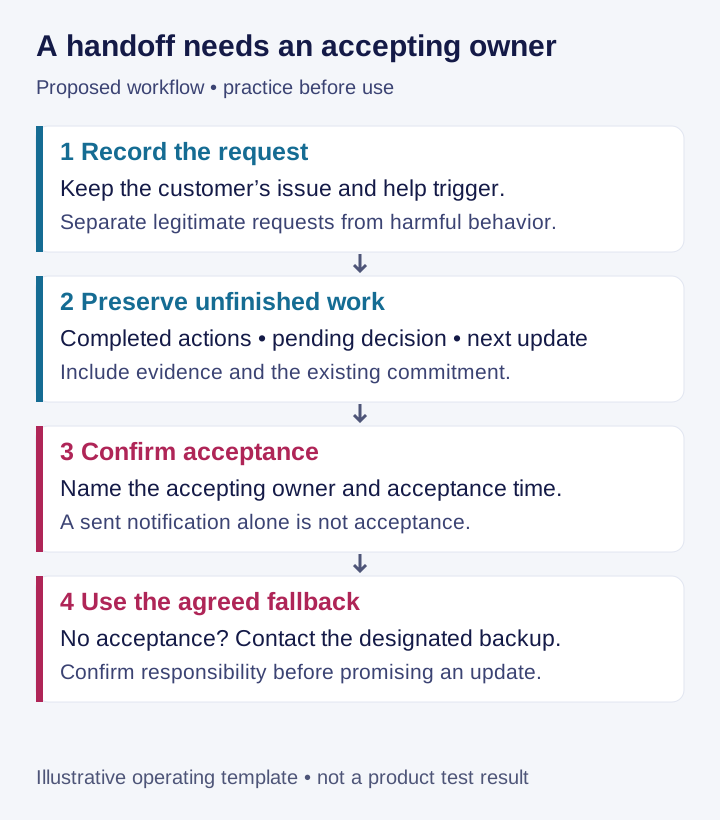
Sending a notification and receiving acceptance are separate events. Until someone accepts, keep the case assigned under the agreed fallback procedure. Don't promise a callback time on behalf of an unavailable colleague.
Practice these three hypothetical situations in supervisor training:
- A dissatisfied customer asks for a refund exception. The agent records the requested exception and the policy limit. The supervisor accepts the decision task, while the record keeps the refund request pending until an authorized decision is made.
- A customer makes personal attacks on an agent. The supervisor follows the organization's intervention policy and arranges support for the agent. The customer's underlying service issue remains assigned for an appropriate response.
- The first supervisor is unavailable. The agent uses the designated backup route. The next owner confirms what they received and the next update they can make. A message sitting unread in a queue doesn't count as a completed handoff.
After a difficult interaction, review whether the promised support was available. If taking a recovery break simply sends every difficult call to one colleague, the workload problem has moved rather than been resolved.
Change the work that keeps causing overload
NIOSH's workplace mental-health guidance puts organizational fixes ahead of relying primarily on individual interventions. Its examples include changing policies that cause stress, giving workers more control and training supervisors. Counseling or resilience resources can support that work; they don't provide queue coverage or decision authority.
Translate the issues raised by employees into a short action record:
| Work issue | Practical change to try | Evidence to review |
|---|---|---|
| Breaks repeatedly disappear during peaks | Assign coverage and a backup for the break period | Whether agents could actually take the planned breaks |
| One group receives most difficult cases | Review routing, skills and the task mix with the team | Difficult-case exposure by shift, alongside volume |
| Agents must ask permission for routine decisions | Clarify approved limits and how to request exceptions | Repeated approval delays and unresolved cases |
| Micromanagement leaves little room to solve a case | Agree on service standards and appropriate discretion | Agent feedback and specific quality findings |
| Shift changes lose context | Use an internal handoff note and require acceptance | Missing actions, repeated questions and overdue updates |
HeroDash's internal notes let a team keep context within a customer conversation and notify or assign a colleague. For a Callnovo-managed support arrangement, use those capabilities to document the pending issue and next owner, then agree on how the team confirms acceptance. A note records the request; the supervisor still needs to confirm acceptance.
A Callnovo e-commerce case: tools and scheduling together
📈 Case in Point: A Southeast Asian e-commerce company partnered with Callnovo to address rising agent turnover. By integrating HeroDash and implementing flexible shift scheduling with live performance tracking, the company:
Reduced agent stress scores by 22%
Increased first call resolution by 18%
Lowered turnover by 30% within 6 months
The case combines technology and scheduling changes; its results do not isolate the effect of HeroDash alone.
If your team needs additional coverage, scope the work, languages, support hours and escalation authority with the Callnovo team. Staffing and software decisions should follow the workload you need to cover.
Review employee engagement and turnover over time alongside the changes you made. Avoid claiming that a change caused an improvement from a before-and-after comparison alone: demand, staffing, case mix and other policies may also have changed. Likewise, a broad industry burnout statistic won't tell you whether your own shift has adequate support.
Review the plan before the next shift
Before calling your call center burnout plan complete, answer three questions:
- What will change in the actual shift? If the answer is only another reminder to stay positive, revisit the workload, tools or authority problem the employee described.
- Who has accepted the next action? If a notification is the only evidence, confirm an owner and a backup before relying on the handoff.
- Can the agent use the support you promised? If taking a break or reaching a supervisor isn't practical, fix the coverage and review it with the team.
Set a review date with the employee and the people responsible for the change. Check what happened, what remains difficult and what needs adjusting next.