

Contact center platform pricing becomes much easier to compare once you know what each provider bills for. A named user, a concurrent seat and a system license are different units. The price on the page may also depend on an annual commitment, a minimum order or a separate telephone bill.
This guide compares six providers and shows how to build a budget from their published terms. It covers software for your customer-service team. Agent wages and outsourced staffing belong in a separate budget. The prices below were checked on November 10, 2026, are in US dollars and should be confirmed with the provider for your location and contract.
What changes the price of a contact center platform?
Start with the license: how many accounts, simultaneous agents or concurrent calls does your operation need? Then add the services that make the platform usable for your team. These commonly include telephone numbers and usage, AI features, storage, implementation and integrations.
Ask whether the advertised monthly figure requires a full year of commitment. Also distinguish the contract term from the invoice schedule. A service can invoice monthly while still requiring an annual agreement.
For a practical comparison, prepare one short requirements sheet. Include your total agents, busiest simultaneous shift, voice and digital channels, incoming and outgoing call volumes, countries called, recording retention needs and existing CRM. Send the same sheet to every vendor. Otherwise, one quote may cover email only while another includes voice routing, and the totals will tell you little.
Keep staffing separate. Buying contact-center software does not hire the people who answer customers. If you also need agents, compare that work through Callnovo's customer-service outsourcing pricing and keep the scope clear in both quotes.
Compare HeroDash, NICE, 3CX, Aircall, Talkdesk and Five9
These are published starting points and selected plans, not equivalent bundles. Read the billing unit and condition alongside every price. The links lead to the providers' own pricing pages.
| Provider | Published price | Billing unit and condition | Budget check |
|---|---|---|---|
| HeroDash | VoicePro or ChatPro: $40 annually billed, $48 monthly; OmniPro: $60 annually billed, $72 monthly | Per account per month; annual figures require annual billing | Telephone numbers and carrier usage are separate |
| NICE CXone | Omnichannel $110; Essential $135; Core $169; Complete $209; Ultimate $249 | Per agent per month for the listed bundles | Compare bundle contents and obtain contract and usage terms |
| 3CX | 8 simultaneous calls: Pro $395/year; AI $575/year | Per system per year, using simultaneous-call capacity | Listed hosting for these 8-call plans is another $295/year |
| Aircall | Essentials $30; Professional $50 | Per license per month, billed annually; minimum 3 licenses | One number included; extra numbers and call destinations affect cost |
| Talkdesk | Digital Essentials $85; Voice Essentials $105; Elite $165; Industry Experience Clouds $225 | Per user per month | Digital Essentials is not a voice package; confirm add-ons and contract |
| Five9 | Digital $119; Core $159 | Per concurrent seat per month; listed offers have a 50-seat minimum | These published bundles do not produce a valid ten-seat quote |
HeroDash: choose channels before adding accounts
VoicePro and ChatPro each cover a different starting scope; OmniPro brings the broader channel choice into one plan. Decide which agents need which workflow before multiplying a price by headcount. Separate the account subscription from carrier and number charges, and ask which AI functions are included or quoted separately. Staff supplied by Callnovo are a separate service arrangement.
NICE: compare the actual bundle
NICE publishes several CXone bundles at different price points. Ask the vendor to map your requirements to one named bundle, then identify anything outside it. The entry price is useful for initial screening, but it does not establish that your required workforce, analytics or AI functions are included. Request the commitment and consumption terms along with the license total.
3CX: size simultaneous calls, not employee accounts
3CX's listed system prices use simultaneous-call capacity. A team with ten employees does not automatically need ten concurrent calls, but you must size the system for the calls it will carry at peak time. Add hosting where required and a suitable telephone service. The annual system license alone is not the operating cost of the phone setup.
Aircall: include the minimum and billing term
Aircall's listed Essentials and Professional figures require annual billing and at least three licenses. One number is included; the pricing page lists additional numbers at $6 per month. Calling allowances depend on the offer and destinations, so ask specifically about your inbound traffic, international calls and toll-free usage. Do not assume either that all calls are included or that every call is extra.
Talkdesk: separate digital and voice requirements
Talkdesk lists Digital Essentials and Voice Essentials separately. If your agents answer the phone, starting a budget with the digital-only price understates the required scope. Decide which channels and functions each group needs, then ask about implementation, add-ons and commitment terms. A user price does not answer those questions on its own.
Five9: respect the concurrent-seat minimum
Five9's advertised Digital and Core bundles use concurrent seats with a 50-seat minimum. If your team is smaller, ask about available commercial options rather than multiplying $119 or $159 by ten. Concurrent licensing also needs a shift plan: count the agents using the platform at the same time, and confirm the vendor's rules for access and capacity.
Turn the advertised price into your monthly budget
Suppose ten agents need access, no more than six handle calls at once, and the team is willing to consider annual terms. These are illustrative assumptions, not a statement about your operation. They let you calculate selected license subtotals, but they do not make all six products functionally equivalent.
| Example | Calculation | What the subtotal leaves out |
|---|---|---|
| HeroDash OmniPro, 10 accounts on annual billing | 10 × $60 = $600/month equivalent; $7,200/year | Carrier usage, numbers and any separately quoted work or add-ons |
| Aircall Essentials, 10 licenses on annual billing | 10 × $30 = $300/month equivalent; $3,600/year | Extra numbers, excluded destinations, add-ons and other quoted charges |
| 3CX 8-call Pro license plus listed hosting | $395 + $295 = $690/year; $57.50/month equivalent | Telephone service, numbers, setup and any extra services |
| Five9 advertised Core minimum | 50 × $159 = $7,950/month at the listed minimum | Usage, add-ons and negotiated terms; this is not a ten-agent quote |
For the 3CX example, the assumed workload still needs a capacity check. Ask your provider how transfers, conferences and other call flows affect simultaneous-call use. For Five9, the example shows why a minimum order matters; request a different offer if the published bundle does not fit your size.
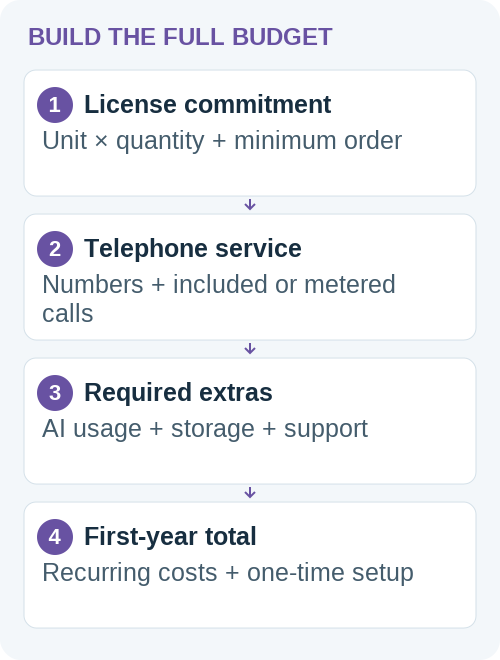
Use this budget formula for each shortlisted offer:
License commitment + phone numbers and usage + required add-ons + recurring support or storage = recurring budget.
Track one-time setup and migration costs separately. To compare first-year cash requirements, add those costs to twelve months of recurring charges, or to the actual annual invoice where applicable. Include taxes or currency conversion in your internal budget where they apply. Do not present a monthly equivalent as a promise of monthly cancellation.
Which costs need a quote?
Some of the most consequential costs depend on your operation. Give the vendor enough detail to answer these questions in writing:
- Telephone service: Which countries and number types are included? What rates apply to your expected traffic, and are there minimum charges?
- AI: Is the feature priced by agent, minute, session or another usage unit? Does a trial allowance expire? What triggers an overage?
- Implementation: Who sets up queues, permissions, CRM fields and routing rules? Is that work included, a fixed project or ongoing paid support?
- Records and storage: How long are recordings and transcripts retained? What does extra retention or export cost?
- Contract changes: What happens when you add or remove agents, need more concurrency or change channels? When can the commitment be reduced?
Ask for both the first invoice and the expected recurring invoice under your stated workload. A discount can make the first year attractive while renewal costs remain unclear. NIST's cloud-computing guidance treats the service lifecycle, portability and provider arrangements as selection considerations. Include the cost of moving in and moving out in your own comparison.
Do not fill blank quote fields with zero. Mark them “to confirm” in your buying worksheet and keep the total provisional until the provider answers. That is especially useful for telephone usage and AI, where volume can change the bill even when your headcount stays the same.
Check the workflow before choosing the cheapest plan
Run a small pilot with the exact plan you intend to buy. Place an incoming call, identify the customer, transfer the request, save the outcome and find it as a supervisor. Repeat with a caller who needs a different department and with a request that cannot be completed immediately.
Then test access. An agent may need customer history without permission to export every record. A supervisor may need recording access that other users do not. The FTC recommends limiting access to what employees need. Check the roles you can actually configure, including any plan restrictions, rather than accepting a broad security label as proof.
Finally, export your test data and check what comes with it. Customer records, notes, recordings and attachments may follow different rules. Our CRM and support-tool trial guide provides a practical sequence for this test.
Choose the offer that supports your required workflow at a cost you can explain. If you want a HeroDash comparison for your team, request a quote with agent count, peak concurrent use, channels, countries and estimated call minutes. Ask for subscription, carrier usage, AI and implementation as separate lines so you can compare the result with the other offers on your shortlist.