

Choosing a CRM for call center teams starts with a simple question: can an agent answer a call, find the right customer and leave a useful record without switching between disconnected tools? A free contact database may help with the second step while leaving the phone connection, call recording and support queue to another paid product.
This guide compares ten CRM and support tools you can start using free, try for a limited period or evaluate through a sales team. Use the comparison to narrow your list, then test the work your agents actually do. Prices and trial terms were checked on November 10, 2026; the linked product pages are the place to confirm your offer before signing up.
Free CRM or free trial: what can your call center actually use?
A free plan lets you keep using a restricted version without a subscription. A free trial opens paid features for a limited time. A sales-arranged evaluation needs an agreed scope and duration before you can test it. These are three different starting points.
For a phone team, check what happens after a customer calls your number. Does the free version identify the caller? Can the agent save notes and create a follow-up task? Does a supervisor see the result? Ask separately about the phone number, outbound minutes, recordings and the connection to your existing phone system.
A CRM stores customer and sales information. A help desk organizes service requests. Contact-center software manages interactions and queues. Some products cover more than one job, but the label alone does not tell you whether a particular plan can handle your workflow.
If you already have a working phone system, connecting it to a CRM may be enough. If you need queues, transfers and supervisor tools as well, evaluate that part alongside the CRM. Avoid moving your customer records first and discovering the calling restrictions afterward.
Compare 10 CRM and support tools for call-center workflows
The table shows how to begin an evaluation. “Free” in the second column applies to the stated plan, not to every telephone feature or service used with it.
| Tool | Free starting point or trial | Check before testing calls |
|---|---|---|
| HeroDash | Evaluation arranged with the sales team | Voice, chat or omnichannel scope; numbers and carrier charges |
| HubSpot | Free CRM for up to 2 users | Calling entitlement and minutes for the selected plan |
| Zoho CRM | Free edition for up to 3 users | Telephony integration and edition requirements |
| Freshdesk | 14-day trial of Enterprise features | Help-desk scope and the separate voice setup |
| Salesforce | Free Suite for up to 2 users | Phone integration and any paid features required |
| Pipedrive | 14-day trial, no credit card required | Calling app, connector and recurring costs |
| Insightly | 14-day trial, no credit card required | Phone integration and the plan needed after trial |
| Bitrix24 | Free plan; 15-day trial of advanced features | Telephony and Market access require a paid plan |
| Agile CRM | Free plan for up to 10 users and 1,000 contacts | Paid-plan requirements for two-way telephony |
| Apptivo | 14-day Ultimate trial, no credit card required | Apps, telephone connection and paid-plan limits |
HeroDash: evaluate the service workflow together
HeroDash is worth evaluating when the team needs a shared workspace for customer conversations and agent activity. Ask for a demonstration using your channels and handoff rules, then agree the trial scope with sales. There is no fixed free-trial duration promised here. Confirm which functions are in VoicePro, ChatPro or OmniPro and which telephone charges sit outside the subscription.
HubSpot: start with a small customer database
HubSpot's free CRM supports up to two users. It can be a starting point for a small team organizing contacts and follow-up work. Do not assume the free CRM includes the calling allowance shown for a paid Sales Hub plan. Have the two test users work through the same customer record and check the exact calling entitlement before expanding access.
Zoho CRM: test a three-person handoff
Zoho CRM has a free edition for up to three users. That gives a small team room to test ownership, notes and follow-up tasks. Confirm whether your telephone provider's connection works with the edition you intend to keep. An integration shown in the product ecosystem may still need a paid CRM edition or a separate provider subscription.
Freshdesk: consider it for service tickets
Freshdesk is a help desk, so evaluate it around cases, assignments and replies rather than sales pipelines. Its current offer includes a 14-day Enterprise trial. Do not budget around the older claim of ten permanently free agents: the current pricing FAQ says unpaid accounts are suspended after the trial. Check how voice conversations reach the ticket and what that setup costs.
Salesforce: distinguish Free Suite from paid editions
Salesforce Free Suite supports two users and includes basic sales and service functions. Test whether its customer and case records suit your process. Phone integration, routing and broader automation need their own checks. Choose against the current edition names and feature lists; older comparisons referring only to Salesforce Essentials can send you toward an outdated offer.
Pipedrive: follow a lead through the sales process
Pipedrive offers a 14-day trial without a credit card. It is a useful shortlist candidate when calls mainly lead to deals, appointments and sales follow-ups. Test the calling app or integration you would actually deploy. Include that app's price in the budget and check whether an agent can log a call without creating duplicate contacts.
Insightly: check the handoff after a sale
Insightly offers a 14-day trial without a credit card. Consider it when customer relationships continue across sales and subsequent work. During the trial, assign a customer to another colleague and check what history follows the record. Verify phone integration and post-trial plan limits instead of assuming that everything visible during evaluation will remain available.
Bitrix24: inspect the telephone restriction first
Bitrix24 offers a free plan and a 15-day trial of advanced features. Its pricing FAQ places Telephony and Market access on paid plans. That makes the paid requirements an early check for a call-center use case. You can evaluate customer records on the free plan, but you should price the calling setup before calling the whole workflow free.
Agile CRM: check the contact ceiling as well as users
Agile CRM lists a free plan for up to ten users and 1,000 contacts. That may give a small team enough room to test record handling, provided its customer list fits. Two-way telephony is a paid-tier feature. Check the required tier, the phone provider and what happens when your contact count grows beyond the free allowance.
Apptivo: choose the apps you will keep
Apptivo offers a 14-day Ultimate trial without a credit card. List the apps your agents use during the trial, then confirm those apps are included in the paid plan you intend to buy. Check the phone connection separately. A successful demonstration on the trial's broad feature set does not establish that a lower plan supports the same workflow.
Choose a shortlist for the work your agents do
Start with the task that creates the most work for your team. If agents call prospects, record deal stages and schedule follow-ups, shortlist around sales records and activity management. HubSpot, Zoho CRM and Pipedrive are reasonable products to investigate for that process; their suitability still depends on your calling integration and plan.
If agents mainly answer delivery questions, handle complaints and pass unresolved cases to another department, test ticket ownership, customer history and reply tracking. Include a help desk such as Freshdesk in that comparison. If queues, transfers and live call handling are central, include the contact-center layer in the evaluation, whether it is HeroDash or another system connected to your CRM.
Give each shortlisted product the same three jobs: identify a returning caller, hand an unresolved request to a colleague and let a supervisor find the full history. A product that handles those jobs clearly deserves a closer look. A long list of features is less useful if agents still have to copy information between screens.
Run a small trial before importing your customer database
Use invented customers for the first test. The FTC's security guidance recommends fictitious information for development and testing and limiting access to what people need. There is no reason to upload your full customer list just to learn how a call note works.
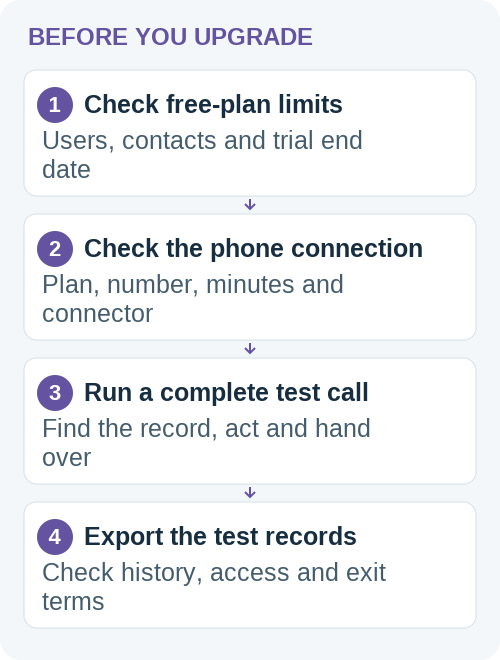
Create two agent accounts and one supervisor account if the plan allows it. Give each person an appropriate role. Then run this sequence:
- Call the test number as an existing customer. Check whether the right record appears, including when more than one contact shares a phone number.
- Make a new request. Save the reason for calling, the next action and the person responsible.
- Transfer or assign the request to the second agent. Check whether the customer would have to repeat the story.
- Have the supervisor locate the conversation and follow-up. Check permissions for recordings and customer details.
- Export the test records and check the result. Confirm how notes, attachments and conversation history are handled.
Record failures in plain language: “Agent two could not see the note” is more useful than a vague low usability score. Retest the important failures after configuration changes. Count setup work as part of the evaluation, especially if every new agent needs manual permissions or a separate app installation.
Check the bill and the exit before the trial ends
Ask for a written cost breakdown for the plan and number of users you intend to keep. Include phone numbers, usage, connectors, recording storage and required add-ons. Confirm the billing term, cancellation date and whether trial features disappear when you move to a lower plan. Our contact center platform pricing comparison explains the differences between user, concurrent-seat and system-based charges.
Check the exit while the test data is still small. Can you export usable customer records and their history? Who closes the account, and what happens to retained recordings? NIST's cloud-computing guidance identifies portability and the full service lifecycle as considerations when selecting a provider. A trial is a practical time to test them.
If HeroDash is on your shortlist, contact Callnovo with your agent count, existing phone system, channels and three test scenarios. Ask for an evaluation of that workflow and a quote that separates the software subscription from telephone usage. That gives your team a concrete basis for deciding whether to proceed.