
A virtual assistant for lawyers takes on the intake calls, scheduling and client follow-up that would otherwise land on your paralegal or on the lawyers themselves. The assistant works remotely under your firm's name, and a lawyer supervises the work.
Whether it pays off depends on decisions you make before the first call: which tasks the assistant runs alone, where an attorney has to step in, how intake runs when clients speak Spanish or Mandarin, and what the hours cost next to an in-house hire. This guide covers each one and ends with a checklist for the contract.
What a virtual assistant for lawyers handles
A virtual legal assistant, also called a legal virtual assistant or a virtual assistant for attorneys, does the administrative side of client work for law firms: intake, calendars, reminders, document collection and billing follow-up. In an office, the same tasks often sit with a legal assistant, a paralegal or the front desk.
It is a different service from a legal AI tool, which drafts text or sorts messages, and from an answering service, which takes a message for a callback. The assistant described here is a person working inside your systems on the tasks you assign.
Before you write the job description for a virtual assistant for lawyers, set the line between their work and your lawyers'. The table below is a starting point; adjust it to your practice area and your state's rules.
| Task | Who does it | Where the lawyer comes in |
|---|---|---|
| Answering new inquiries by phone, email and web form | Assistant | Reads the intake summary |
| Asking the firm's intake questions and collecting documents | Assistant | Decides whether to take the matter |
| Initial conflict check in your case management system | Assistant runs it | Makes the final conflict decision |
| Scheduling consultations and keeping the calendar current | Assistant | Sets the booking rules |
| Document preparation from the firm's templates: client details, formatting, file organization | Assistant prepares | Reviews anything that goes out as legal work |
| Case management updates: logging calls, updating matter status, sending reminders | Assistant | Decides what clients are told about their case |
| Billing follow-up: sending invoices and payment reminders | Assistant | Handles fee disputes and exceptions |
| Legal research, case evaluation and legal advice | Lawyer | Stays with the lawyer |
| Fee negotiation and explaining the engagement agreement | Lawyer | Stays with the lawyer |
The last two rows are the ones to write into the contract and the scripts. The next section explains why the conflict check and the fee conversation sit where they do.
Intake and conflict checks: where the assistant stops
An assistant can run most of intake, including the first conflict check. The conflict decision, and any conversation about fees or the engagement terms, belongs to an attorney.
The American Bar Association sets out this split in Formal Opinion 506 (ABA, 2023). In the opinion's terms, a nonlawyer is anyone assisting the firm who is not a licensed lawyer. A lawyer may train and supervise a nonlawyer to assist with prospective client intake, including obtaining initial information about the matter and performing an initial conflict check. The opinion counts contractors and vendors among those nonlawyers, so it covers an outside assistant as well as staff.
Two limits come with it:
- When a relevant or closely related name comes up in the conflict check, the lawyer must review it and make the final determination of whether a conflict exists and whether it can be waived.
- When a prospective client wants to negotiate fees or expenses, asks which legal services they need, or asks what the engagement agreement means, the lawyer has to respond. A nonlawyer can still explain how the firm charges, for example by the hour, on contingency or at a fixed fee.
The opinion also states that lawyers who delegate do not give up their own responsibilities under the Model Rules. ABA opinions interpret the Model Rules. Your state's rules of professional conduct are the ones your firm answers to, and the definition of the practice of law varies from one jurisdiction to another.
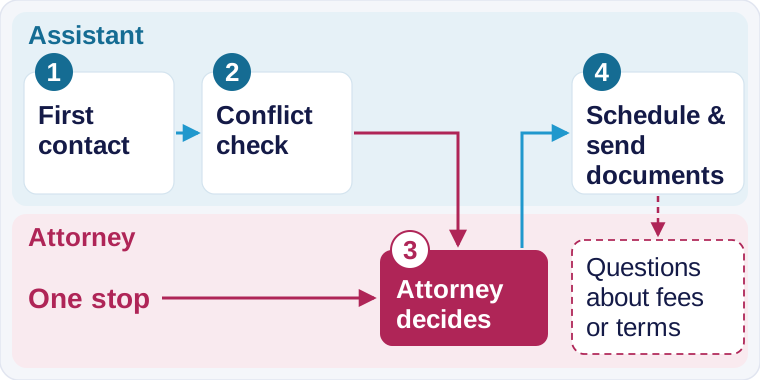
The four steps listed below, with step 3 as the attorney's stop.
A workable intake flow puts one stop in the middle:
- The assistant takes the first contact and records the names of all relevant parties, the dates involved and the nature of the matter.
- The assistant runs the initial conflict check in the firm's system. The search covers the other parties, witnesses and opposing counsel as well as the client, and the assistant lists any matches.
- An attorney reviews the matches, decides on any conflict and decides whether the firm will take the matter.
- Only then does the assistant schedule the consultation and send the firm's standard engagement documents. Questions about fees or the agreement's terms go to the attorney.
For a law firm, the intake script is where this line lives. List the questions the assistant may answer, how to answer them, and the ones that go to a lawyer. The opinion says a lawyer must give intake staff policies, training and supervision on exactly that point.
Running intake in your clients' language
Have the assistant collect the facts in the client's language and give the lawyer an English summary. Conversations that involve legal advice stay with the lawyer, through a qualified interpreter when the lawyer does not speak the language.
ABA Formal Opinion 500 (ABA, 2021) deals with language access. When a lawyer and a client do not share a language, the lawyer's duties of communication and competence are undiminished. When reasonably necessary, the lawyer should arrange for an impartial interpreter or translator who can accurately explain the legal concepts involved.
The opinion describes two ways to staff that. In most situations, checking an interpreter's skill is best done by engaging an outside professional. As an alternative, a lawyer may look to a multilingual lawyer or nonlawyer staff member within the firm to facilitate communication, though the lawyer should proceed cautiously with a nonprofessional interpreter. Interpreters and translators fall under Model Rule 5.3, which covers the nonlawyers a lawyer employs or retains, and the arrangement should address the protection of client information.
That points to a simple split for a law firm virtual assistant who speaks the client's language. The assistant runs the administrative conversation: intake questions, the document list, scheduling and reminders. The lawyer runs the legal one, with an interpreter when needed.
A partner at a Los Angeles immigration firm described their setup on our page about a bilingual virtual assistant for immigration lawyers: "We were getting 30+ new inquiries a week from China. Our paralegal was overwhelmed. We brought in a Callnovo VA for 20 hours a week. Now, 80% of intake is handled before the lawyer even sees the file. We've cut onboarding time by half."
Here is how the steps divide when the client speaks Spanish, Mandarin or another language:
| Intake step | Language | Who handles it | What the lawyer receives |
|---|---|---|---|
| First contact and screening questions | Client's language | Assistant | Contact details, type of matter, how the client found the firm |
| Facts, dates and parties | Client's language | Assistant | An English timeline, with names, dates, amounts and ID numbers also kept as the client gave them |
| Document checklist and follow-up | Client's language | Assistant | A list of what has arrived and what is missing |
| Conflict check entry | English, with names also in the original script | Assistant | The match list for review |
| Consultation and advice | Client's language, through the lawyer or a qualified interpreter | Lawyer | Nothing to summarize: the lawyer is in the conversation |
| Reminders and status updates after the consultation | Client's language | Assistant, using wording the lawyer approved | A log of each contact |
What the lawyer receives in English
The summary is what the lawyer reads before deciding anything, so agree on its format before the first inquiry. A one-page format that works across languages:
- The client's name as written in their own script and in English letters, plus any other names they use
- The other parties, witnesses or companies involved, in both forms
- A dated timeline of events in English
- Key phrases in the original language with an English rendering beside them, for anything the facts may turn on
- Documents received and documents still missing
- Questions the client asked that the assistant passed to the lawyer
Keeping names in both forms matters twice: once for the conflict check, and again when the lawyer compares the summary with the client's own documents. For Mandarin-speaking clients, a separate guide covers how Mandarin-English legal assistants handle client follow-up.
Handoffs across time zones
If the assistant works from another country, settle three things in writing:
- Covered hours in your time zone, including the hours your clients actually call. For clients in China, for example, the US evening is their morning.
- A daily handoff time, when the day's English summaries reach the lawyer.
- An urgent path: who the assistant calls, and how, when a prospective client mentions a hearing or filing deadline within days.
Callnovo staffs native-level agents across 65+ languages from 26 delivery countries. For a law firm, the covered hours and the handoff time are agreed in the quote.
What a virtual assistant for lawyers costs
Estimate the hours first, from your weekly inquiry count and follow-up load. Then price an in-house hire and each outside quote on those same hours.
For the in-house side, federal wage data puts the median hourly wage for paralegals and legal assistants (SOC 23-2011) at $30.24 in May 2025 (BLS, 2025). That figure is wages only. It excludes overtime and the employer's cost of benefits. The occupation also covers fact investigation and drafting, so treat it as the cost of the hire you would otherwise make, not as a match for an intake-only role.
As a worked example, with the hours as an assumption: an employee working 20 hours a week at that median earns $30.24 × 20 × 52 = $31,449.60 a year in wages. Benefits, recruiting, training and the time a lawyer spends supervising come on top. Supervision time applies to an outside lawyer virtual assistant too, so count it on both sides.
Outside providers price the same hours in a few ways, and each one rewards something different. Ask every provider the same questions:
| How you're billed | What the fee covers | Suits | Ask before you sign |
|---|---|---|---|
| Block of hours | Prepaid hours drawn down as they are used | Uneven intake, or a trial period | The minimum block, when unused hours expire, and whether training time is billed |
| Part-time fixed hours | A set number of hours each week with the same person | A solo or small practice with steady intake | Who covers absences, and whether unused hours roll over |
| Full-time dedicated assistant | One person's full schedule, working only for your firm | Daily intake volume, or bilingual intake | The notice period, how fast a replacement starts, and what supervision is included |
Whichever model you choose, hire on the same number of hours you used for the in-house estimate, so the two figures compare. For how a dedicated seat differs from a shared team in control and cost, see our guide to dedicated customer service.
Callnovo's published English rate for weekday phone answering (Monday to Friday, 9 a.m. to 5 p.m. Eastern Time) starts from US$5.80 hourly for each agent. Virtual assistant scope for law firms is quoted per project.
On the return side, our client data shows firms saving up to $50,000 a year for each assistant, working 20% faster and seeing client satisfaction 15% higher.
Starting small: a virtual assistant for solo lawyers
For a solo practice, a virtual assistant for solo lawyers can start on a few fixed hours a week covering first replies, scheduling and document reminders, then grow with the inquiries.
A solo practitioner in Sydney, quoted on the same bilingual immigration page, described the change: "I used to answer every message myself. Now my VA handles the first 3 rounds of communication. I look more responsive, my clients are happier, and I've freed up 10+ hours a week."
Before you ask for quotes, track the time you spend on first replies and scheduling for two weeks. That count sets the size of the first block.
How to choose among virtual legal assistant companies
Run each candidate through your own intake script, in the language your clients use. A test inquiry shows more about how a company handles intake than its sales material does.
Some products sold as virtual legal assistant services are AI tools that draft text or route messages. This section is about virtual legal assistant companies that put a person on your intake under a lawyer's supervision. When you compare legal virtual assistant services of that kind, write three test inquiries and have each company's assistant handle them while you listen in or read the transcript:
- A routine new inquiry in English. Check the questions asked, the conflict-check entry and the summary.
- The same inquiry in Spanish or Mandarin. Check the English summary against what the caller said, especially names and dates.
- A caller who asks "Do I have a case?" or "Can you lower the fee?" The right response is to take the details and pass the question to a lawyer.
Then ask each company to show you the following:
| What to check | What to ask the company to show |
|---|---|
| Supervision | Who supervises the virtual legal assistants day to day, and how your lawyer's instructions reach them |
| Access to client files | Which systems each assistant can open, using logins your firm issues and can revoke |
| Offboarding | How and when access is removed when an assistant leaves or is replaced |
| Conflict-check procedure | How they run the initial check in your system and where matches are sent |
| Coverage and backup | The hours covered in your time zone, and who steps in during absences |
| Confidentiality | The confidentiality terms in the contract, and how client information is protected in their workflow |
| Language | A recorded or written intake sample in the client's language, with its English summary |
If the company assigns more than one person, ask whether the same virtual assistants stay on your firm's account from month to month.
Callnovo assigns dedicated assistants who work only for your firm, in the languages your clients speak. You can start with half a seat or grow to 200+ seats; the smallest option suits part-time intake hours. It fits firms that want the same person on intake every week and have clients who need Spanish, Mandarin or another language.
Before you sign: a checklist for your firm
Confirm that each of these is written into the statement of work or the contract:
- The task table: what the assistant does, what it prepares, and what stays with the lawyer
- The conflict-check steps and the point where an attorney decides
- The questions the assistant may answer, and the ones that go to a lawyer, including any about fees or the engagement agreement
- The languages covered and the format of the English intake summary
- Who supervises the assistant, and the confidentiality terms for client information
- The system access granted, and how it is removed at offboarding
- Covered hours, the daily handoff time and the urgent path
- The billing model, minimum hours and how absences are covered
- A trial period, with the three test inquiries as the acceptance check
With your weekly inquiry count and your intake script in hand, you can ask any provider for a quote on the same hours. Send both to the Callnovo team for a quote on your firm's scope.
FAQ
Does a virtual legal assistant need to be in the US?
The deciding questions are practical: whether the assistant covers the hours your clients call, speaks their language, works inside systems your firm controls, and reports to a lawyer who supervises the work. Wherever the assistant works, the supervision and confidentiality duties described above stay with your lawyers, so write the covered hours, the handoff time and the confidentiality terms into the contract.
References
- American Bar Association — Formal Opinion 500, Language Access in the Client-Lawyer Relationship (October 6, 2021)
- American Bar Association — Formal Opinion 506, Responsibilities Regarding Nonlawyer Assistants (June 7, 2023)
- U.S. Bureau of Labor Statistics — Occupational Employment and Wage Statistics, Paralegals and Legal Assistants (23-2011), May 2025
- Callnovo, Bilingual Virtual Assistant for Immigration Lawyers (client quotes)
- Callnovo, pricing for dedicated human support