
B2B customer service is the support a company gives to the businesses that buy from it. The channels are familiar: phone calls, emails, tickets. What differs is the customer. One account has several people who contact you, the relationship runs on a contract, and in many industries a dealer stands between you and the person using the product.
That structure decides which parts of the work you can hand to an outsourced team. This guide explains how B2B support differs from B2C, how to split the work between your own staff, your dealers and a B2B call center, and what the contract should cover.
What is B2B customer service?
B2B customer service is business-to-business support: help with orders, setup, use, faults and after-sales for customers that are companies rather than individual consumers. The customer might be a contractor running your machines, a clinic using your equipment or a firm whose staff log in to your software. In practice, B2B customer support and B2B customer service mean the same work.
How B2B customer service differs from B2C
Most of the gap in B2B vs B2C customer service comes from how the customer is organized.
| Area | B2C customer service | B2B customer service |
|---|---|---|
| Who the customer is | One person or household | A company account with several contacts |
| What sets the service | A standard return and warranty policy | A contract, a support tier and often an SLA |
| Typical issue | Order status, a return, a simple fix | Installation, integration or a fault that stops work |
| Channels | Phone, email, chat, self-service | The same, plus a portal, an account manager and often a dealer |
| How long the relationship runs | One purchase at a time | Years, renewed on contract |
| What one failure costs | One unhappy customer | Downtime for the customer's team and a harder renewal |
B2B issues are often more complex, and the relationships behind them last for years, so two things follow. First, an agent has to know which account is calling, which product and version it has and what its contract covers before promising anything. Second, a fault is judged by its effect on the customer's operations. One broken unit on a site with twenty spares is routine; the same fault on the only unit on a production line is urgent.
Who contacts B2B support: users, admins, dealers and head office
A business account has multiple stakeholders, and each brings different requests. Forrester's survey of nearly 18,000 business buyers found that, on average, 13 internal stakeholders and nine external participants influence a buying decision (Forrester, 2026). That count covers the purchase, but the same spread of roles shows up after it.
| Who contacts you | Common requests | Usually handled by |
|---|---|---|
| Daily users and operators | "It stopped working," how-to questions, error codes | First-line support |
| Admins and IT | Access, licenses, settings, integrations | First line, then your technical team |
| Procurement and finance | Invoices, renewals, contract terms | Account manager or finance |
| Dealers and channel partners | Repair requests for their customers, parts, technical documents | Your dealer support line or technical team |
| Your own head office | Service quality, recurring faults, feedback from end users | Reports from whoever runs support |
Dealers change the picture most. When a dealer sold the equipment, the end user may call the dealer first. Routine after-sales problems can be handled there without ever reaching your head office. If dealers take most after-sales calls, ask how much of what customers report actually gets back to you. Mindray, a medical equipment maker, outsourced after-sales service and satisfaction surveys for its Middle East, European and US markets to Callnovo for that reason: to get closer to the end customers its headquarters was not hearing from.
How to split B2B support between your team, your dealers and a call center
A B2B call center is an outsourced team that handles contact between a company and its business customers. Some B2B call centers sell, setting appointments and qualifying leads; for that work, see our guide to appointment setting services. This section is about support.
Split the work by type of request. Intake, documented troubleshooting, scheduling, status updates and follow-up calls suit an outsourced team. Engineering diagnosis, warranty decisions and anything that commits money or changes a contract stay with you.
Which B2B support work fits an outsourced team
Before you assign work, decide how customers reach you when a dealer is involved. There are three common models:
- Dealer first: the customer calls the dealer, and the dealer escalates to you. This suits products that need frequent on-site service.
- Manufacturer first: the customer calls a central support line, which sends the dealer when someone has to go on site.
- Hybrid: both routes exist, with one shared case record and written rules for who owns what.
Whichever model you pick, the outsourced team should work alongside your dealers rather than around them. A support line that quietly bypasses dealers damages the channel you rely on for on-site work.
With the model set, assign the work:
| Work | Outsourced first line | Your team | Dealers | Hand off when |
|---|---|---|---|---|
| Logging requests and checking the account | Answers calls and emails, identifies the account, product, serial number and contract | Writes the entitlement rules | Logs requests from their own customers | The account or entitlement is unclear |
| Known problems | Walks through documented checks from your knowledge base | Writes and updates the knowledge base | Handles local checks that need a qualified technician | The documented checks do not fix it |
| B2B technical support beyond the checks | Collects logs, versions and the steps already tried | Engineering diagnosis, fixes and security issues | Field diagnosis within their authorization | Always, with a complete case record |
| Repairs and parts | Books the visit, tracks parts, updates the customer | Approves warranty, replacements and exceptions | Installation, repair and parts replacement | A warranty or cost decision is needed |
| Commercial questions | Records the request | Renewals, pricing and contract terms | Their own customer agreements | Immediately |
| After the fix | Calls back and records satisfaction | Reviews recurring faults | Confirms on-site work is done | A complaint or repeat fault appears |
This matches how many technology companies already run support. Deloitte surveyed 160 B2B technology support leaders. In the standard tiered model it describes, outsourcing typically covers the first line, which handles most incoming requests, while second tier and above stay with internal employees (Deloitte, 2024).
The international standard for customer contact centers draws the same line from the other side. ISO 18295-2, written for organizations that use contact centers, notes that a contact center is not responsible for certain aspects of products and services, which remain the responsibility of the client (BSI, 2017). The outsourced team can run the conversation; the decisions about your product stay with you.
For more on scoping technical work, see our guide to outsourced technical support.
How a repair request moves from report to resolved
The table assigns the work. The next job is to keep one case moving between three parties, with communication in one record, so the customer does not have to explain the problem three times. Liugong's Thailand contact center shows one way to do it.
In 2019, Liugong, the construction machinery maker, launched a contact center in Thailand run by a dedicated Callnovo team that provides customer service and technical support. Thai customers report problems through a toll-free number. Callnovo's write-up of the launch describes how each case then moves:
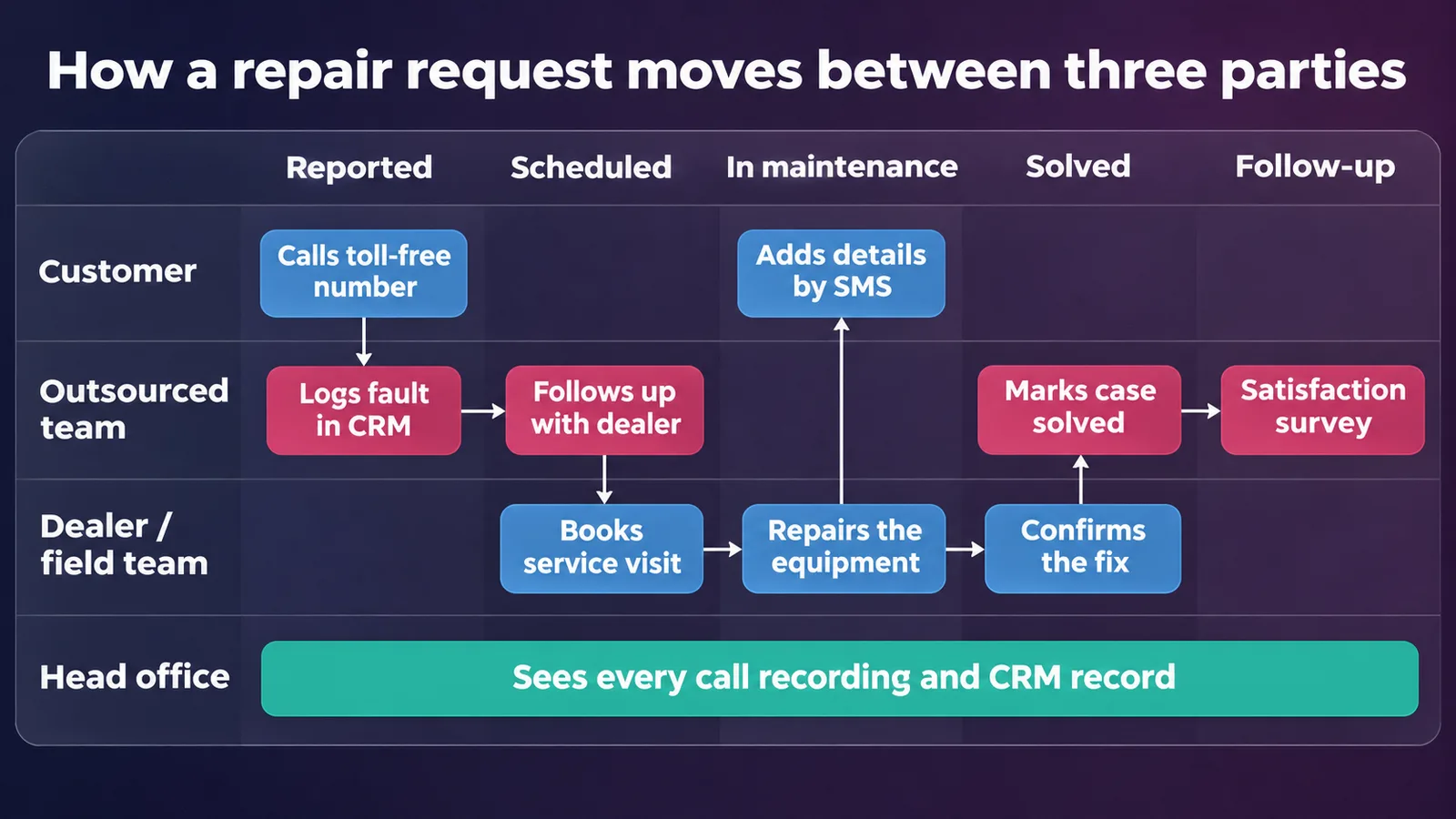
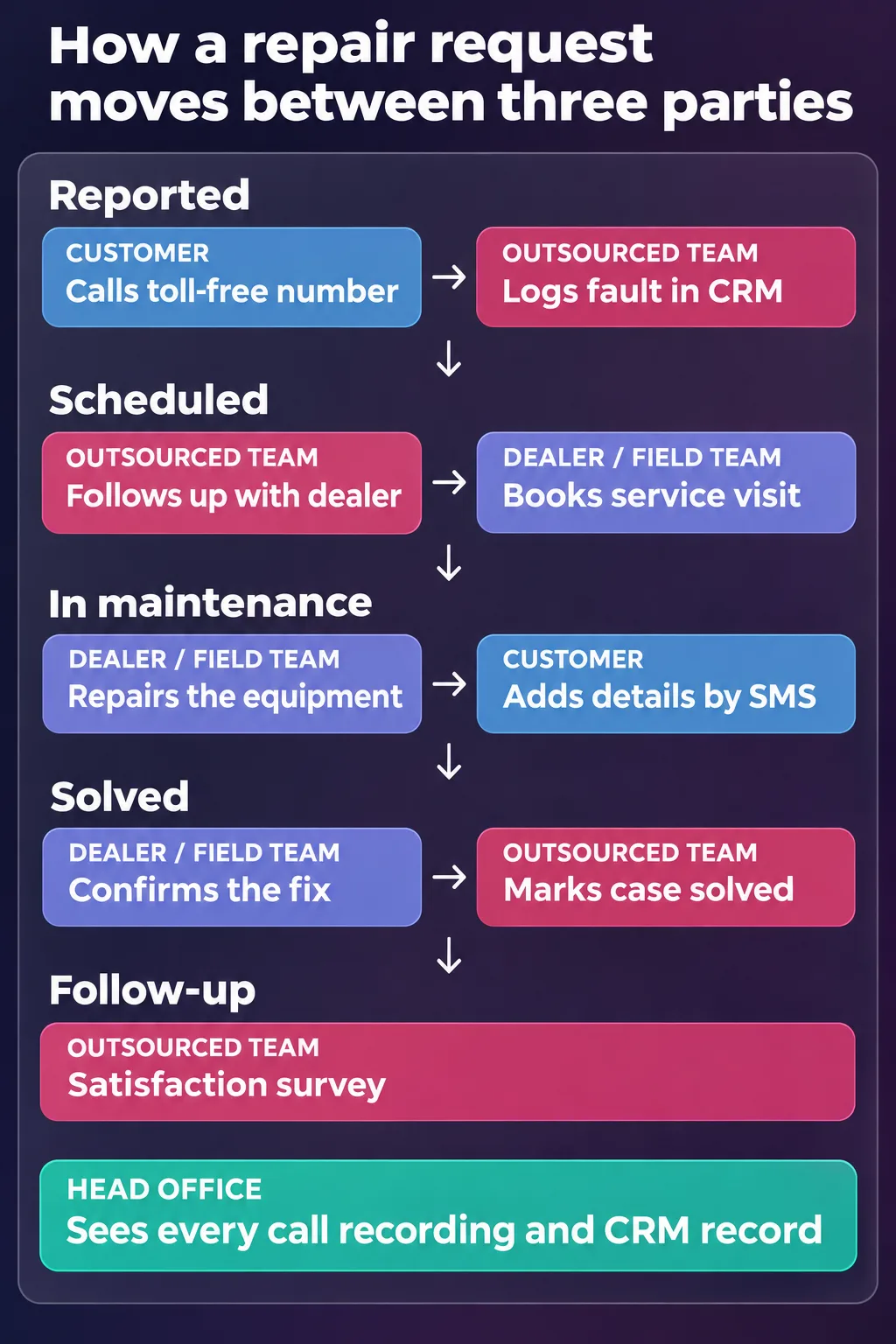
- Issue reported. The customer calls the toll-free number, and the agent records the fault in the CRM.
- Task scheduled. The agent follows up with the distributor and the customer, and the service visit is booked.
- In maintenance. The record shows the repair is under way.
- Problem solved. The record is marked solved once the fault is fixed.
- Follow-up. The team runs a satisfaction survey with the customer.
Customers can also add information to the record by replying to an SMS, without logging in to the CRM.
Liugong's head office in China can open every call recording and every CRM record. That access answers the dealer problem described earlier. Head office does not have to rely on summaries from the distributor; it can see what customers reported and where each case stands. Read the Liugong Thailand contact center launch for the full account.
To copy the pattern, write down three things for each stage:
| Stage | Who owns it | Who is told |
|---|---|---|
| Reported | Outsourced team | Customer gets a case number |
| Scheduled | Outsourced team with the dealer | Customer gets the visit time |
| In maintenance | Dealer or your field team | Customer can check or add details |
| Solved | Dealer or your field team confirms; outsourced team closes | Customer and head office |
| Follow-up | Outsourced team | Head office sees the survey result |
Covering customers and dealers in other countries
Selling abroad adds three questions: which languages each market needs, whether someone is on duty during that market's working day, and whether customers can reach you on a local number at all. The third is easy to miss. If customers can only reach you on an international number, someone with a routine fault may call the dealer instead, or not call at all.
Yutong, the bus maker, is an example. In March 2019, Yutong outsourced English and French customer surveys and satisfaction callbacks for its African markets to Callnovo. Callnovo also applied for local city numbers on Yutong's behalf in Australia, Colombia, Russia and Africa, and connected phone, SMS and email to Yutong's Salesforce CRM. Agents could see caller information as calls came in, call back on completed tickets and record survey results, while managers assigned the callback tasks.
Plan each market on one line:
| Market | Languages | Customer working hours | Number type | Follow-up channel |
|---|---|---|---|---|
| Thailand (Liugong) | Local languages | Local business day | Toll-free | Phone and SMS |
| African markets (Yutong) | English, French | Local business day | Local city numbers | Phone callbacks |
| Your market |
Start with the languages your customers and dealers actually use. For more on staffing several languages, see our multilingual call center guide.
What outsourced B2B support costs
Outsourced support is billed per minute, per agent hour or as a shared package. Pick the billing unit from your volume and the hours you must staff, then compare prices.
| Billing | Callnovo starting rate | Suits |
|---|---|---|
| Per minute | Phone support from US$1 a minute | Low or irregular volume |
| Shared team | English phone answering from US$650 per month for 1,500 minutes, on weekdays 9am to 5pm Eastern | Small queues that share agents |
| Dedicated agent | One agent on your account from US$5.80 per hour, on weekdays | Steady work on your own products |
Evenings, weekends and 24/7 coverage are scoped for each project. B2B queues are often small but technical, so a dedicated agent who learns your products and dealers tends to suit them better than a shared pool. To compare quotes on the same month of work, use our guide to call center pricing, and see shared or dedicated customer service for how the two models differ.
How to choose a B2B call center
Most B2B support tools and platforms decide where cases are handled. Choosing an outsourced team decides who handles them. Ask each provider:
| Question | Why it matters | What to look for |
|---|---|---|
| Have you supported products sold through dealers or distributors? | Dealer handoffs are where cases stall | A described process with named stages |
| Can you work in our CRM or ticketing system? | Your head office needs one record | Experience with your system, such as Salesforce |
| Will we get every call recording and case record? | You keep visibility and the data | Access written into the contract |
| Can you cover our markets' languages and hours? | Customers abroad need someone on duty | Staffing by market, not a total language count |
| How do you escalate to our engineers and dealers? | Bad escalations waste specialist time | Required case fields and handoff times |
| What do you report on? | Speed alone can hide unresolved issues | Reopened cases and survey results, not only handle time |
Callnovo runs seat-based customer service and technical support teams for B2B companies, including the Liugong and Yutong programs described above. For a wider list of providers, see our comparison of call center outsourcing companies.
What to put in the contract and SLA
For an outsourced team, B2B customer service best practices have to be written into the contract, because the contract decides what the team is paid for. Deloitte found that the incentives of outsourcing agreements typically encourage quick closure of cases, which can come at the expense of accurate resolution and the customer experience (Deloitte, 2024). SLAs are where you correct for that. A ticket closed too early comes back as a repeat call, and in B2B a pattern of repeat faults puts renewal revenue at risk.
| Clause | What to write | Why |
|---|---|---|
| Severity levels | Definitions by business impact, such as "work stopped" or "workaround available" | Urgency follows the customer's operations, not the caller's tone |
| Response times | A first response time for each severity | Customers know when someone will act |
| Escalation times | How fast cases reach your engineers or dealers, and what the case must contain | Stops cases stalling between parties |
| Separate clocks | Response, escalation, restoration and final resolution measured separately; when the clock pauses; a transfer does not restart it | Avoids reports that look good while customers wait |
| Status updates | Who updates the customer at each stage, and how often | Customers stop chasing |
| Resolution quality | Reopened cases, repeat faults and survey results reviewed each month | Rewards fixing over closing |
| Data | Call recordings, case history and the knowledge base belong to you, with export on exit | You keep the record if you change provider |
| Coverage | Languages, hours and holidays for each market | Matches what you promised your customers |
| Reporting | Monthly report and review meeting | Problems surface early |
Deloitte's survey shows what support teams measure most often: mean time to resolve (61% of respondents), mean time to respond (53%), incidents prevented or proactive tickets (41%) and callbacks to check in with customers (41%). Keep the speed metrics, and add reopened cases and follow-up results next to them.
The standard also places a duty on you. ISO 18295-2 is written for the client organization rather than the contact center, so plan your own side: knowledge base updates, escalation contacts and a named owner for the relationship.
Before you sign, check that:
- Every type of request has an owner, a handoff point and a time limit.
- Dealers know how cases reach them and how they report back.
- Head office can see recordings and case records without asking.
- Each market has its languages, hours and a number customers can reach.
- The SLA measures resolution quality as well as speed.
For a template to send to providers, use our call center outsourcing RFP.
FAQ
What does a B2B call center do?
A B2B call center handles phone, email and chat contact between a company and its business customers. Some B2B call centers sell, setting appointments and qualifying leads; others support existing accounts by taking repair requests, answering product and order questions and following up after a fix. When you outsource support, you are buying the second kind.
Is B2B customer service the same as account management?
No. Account management covers the commercial relationship: renewals, pricing and the plan for the account. Customer success teams work on adoption and results. B2B customer service handles the day-to-day requests and problems that come in from the account's users, and it hands commercial questions to the account manager rather than answering them.
Can a call center handle technical support for business customers?
Yes, for first-line work: logging the fault, collecting serial numbers and versions, walking through documented checks and booking a technician or engineer when the checks do not fix it. Engineering diagnosis, warranty decisions and changes to a customer's system should stay with your own team or an authorized dealer.