

A BPO call center is an outside provider that runs agreed customer-contact work for your business. For a growing company, that might mean answering order questions while your own team handles purchasing, product issues, and refund decisions. For the buyer, the key is knowing which daily responsibilities the provider will take over.
Some services include hiring, schedules, training, supervision, and quality reviews. Others cover a narrower task or shift. Before comparing prices, define the work you need done and the decisions you want to keep inside your business.
What is a BPO call center?
BPO stands for business process outsourcing: assigning a business process to an outside provider. Customer support is one possible process; payroll administration and other back-office work also fall within the broader category. A BPO provider does not have to be an IT company.
The distinction in "BPO vs call center" is between who runs the work and what the team does. A call center is a customer-contact operation that can be run in-house or by a contractor. BPO call centers put an outside provider in charge of that work. In a BPO call center, the client and provider agree on the tasks, staffing, and responsibilities included.
Phone calls are only part of the possible scope. The U.S. Census Bureau's 2022 NAICS classification describes call-center work that includes telephone, email, and other communications for orders, information, and assistance. It also covers operations serving other establishments within the same enterprise. The name alone therefore does not tell you whether a team is outsourced or which channels it supports.
Call-center software supplies tools such as call routing, a queue, and reporting. Cloud delivery is often called contact center as a service, or CCaaS. Buying those tools leaves hiring and running the support team with you unless a separate service includes that work. A BPO arrangement may use your existing software or the provider's systems; confirm both the operating responsibilities and the licenses included.
How BPO call center services are organized
BPO call center services can be described along several different lines. Inbound and outbound describe who starts the contact. Voice, email, and chat describe the channel. Shared and dedicated describe the staffing arrangement.
On narrow screens, scroll horizontally to see all columns.
| Service | What the team handles | What to specify |
|---|---|---|
| Inbound support | Customers calling or writing for help, order status, or troubleshooting | Request types, hours, languages, and escalation routes |
| Outbound support | Follow-up calls, appointment confirmations, or other agreed outreach | Purpose, approved audience, scripts, and applicable contact rules |
| Digital support | Email, live chat, and other agreed messaging queues | Response expectations, queue ownership, and how conversation history is kept |
The phrase "BPO contact center services" often signals support across several channels. Ask which channels are actually included and whether a customer who switches from chat to phone keeps the same case history. A list of channel logos cannot answer that operational question.
With shared staffing, human agents handle work for more than one client. Ask how your work gets priority when several queues become busy. With dedicated staffing, human agents are assigned to your account under the agreed arrangement. Confirm whether management and backup coverage are dedicated too; the label does not settle every role.
Delivery location is another separate choice. Onshore, nearshore, and offshore describe the relationship between your market and the team's location. For a U.S. business, check the actual coverage in your time zone, including daylight saving changes, along with language skills and holiday coverage. Location by itself does not establish service quality or the final cost.
What work can a BPO team take over?
When you outsource support operations, name the actions the team will perform: look up an order, explain a delivery status, collect evidence for a claim, update the customer record, and route a decision to the right person. “Customer service” is too broad to tell either side when a task is finished.
Our work with an anonymous Hong Kong logistics business, BS, shows what this can involve. The BS logistics case covered chat and email inquiries about parcel declarations, tracking, exceptions, pickups, and lost-parcel claims. Human agents needed logistics knowledge as well as language skills. New hires had to pass theory and simulated-service assessments before handling customers.
Callnovo also handled recruitment, attendance management, quality assurance (QA), and replacement staffing, with a single project contact for the client. Those management tasks explain what the client was buying beyond time spent answering messages. In this single case, Callnovo reported human labor costs 40% below a Hong Kong in-house team in its September 2026 case account.
For your own team, turn the service description into a division of work. This illustrative logistics handoff shows how to separate execution from approval; it is not BS's contract.
On narrow screens, scroll horizontally to see all columns.
| Request | Work assigned to the BPO team | Decision retained by the business |
|---|---|---|
| “Where is my parcel?” | Check the shipment record, explain the current status, and record the reply | Set the approved tracking sources and customer promises |
| “Tracking has stopped updating.” | Collect shipment details and send an escalation with the checks already completed | Investigate with the carrier and authorize an exception |
| “I want compensation.” | Collect the claim documents, explain the process, and update the customer | Approve or reject compensation under the business's policy |
The next person needs to be able to find the handoff record. If the team uses your customer relationship management (CRM) system, agree which fields it can change and how it records the next owner and promised follow-up. Otherwise, a correctly answered chat can still leave the rest of the business without the information it needs.
Quality assurance should examine those actions. A friendly reply is useful, but so are the correct shipment reference, an accurate explanation, and a complete escalation. Use training examples that match the requests the team will receive, then review disputed answers together so that the next person has a clear instruction.
How to compare BPO costs on the same basis
Start with one period and one service scope. Ask each provider to price the same request types, channels, languages, coverage hours, and expected volume. Then identify whether it charges by staffed hours, a monthly allocation, contacts, or another unit. A "seat" also needs a definition: it may describe a person, a software license, or capacity available during a shift.
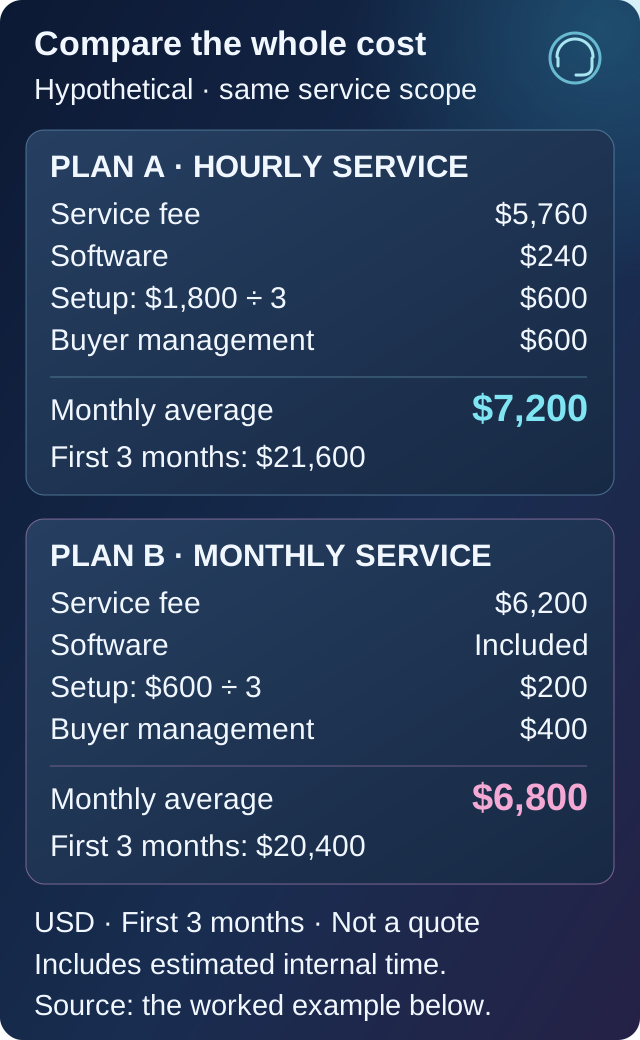
The following is a hypothetical comparison for the first three months of the same support workload. All amounts are U.S. dollars. The rates are illustrative, not market averages or Callnovo prices.
On narrow screens, scroll horizontally to see all columns.
| Cost item | Plan A: hourly service | Plan B: monthly service |
|---|---|---|
| Service fee per month | 320 billed hours × $18 = $5,760 | $6,200 |
| Software per month | $240 | Included |
| One-time setup and training | $1,800 | $600 |
| Buyer management time per month, valued at $40/hour | 15 hours = $600 | 10 hours = $400 |
| Total for the first three months | $21,600 | $20,400 |
| Average per month over that period | $7,200 | $6,800 |
For Plan A, the calculation is 3 × ($5,760 + $240 + $600) + $1,800. For Plan B, it is 3 × ($6,200 + $400) + $600. Plan A's lower service fee becomes the higher total once the other assumptions are included. Buyer management time is an estimated internal cost, not a charge on the provider's invoice.
This comparison only holds if both plans can meet the same workload and service requirements. Ask what happens when demand exceeds the quoted volume and whether unused capacity carries over. Check the minimum commitment, billable training or absence time, holiday rates, and the notice needed to change staffing. Include an in-house option using the same period and work, with the employment, supervision, tools, and coverage costs relevant to your business.
For chat, distinguish elapsed conversation time from active handling time: the minutes a human agent actually spends reading, investigating, replying, and documenting. Several open chats can include customers waiting for a delivery update. Dividing labor cost by the maximum number of simultaneous chats does not establish the work completed or the cost per resolved issue. Use your own demand data and account for repeat contacts and unfinished work.
When to choose an in-house team, software, or a BPO provider
Look at what is preventing the queue from working well. If you have enough trained people but calls route badly and customer history is scattered, evaluate the software and process first. CCaaS or a better-configured help desk may address that problem while your team continues to run the operation.
If the gap is hiring, shift coverage, supervision, or maintaining a trained replacement pool, a BPO provider is relevant. Ask the provider to show who owns those functions in its proposal. Access to technology alone will not explain how an absent team member's shift gets covered.
An in-house team can be the practical choice when most requests require frequent decisions from people with deep product or customer knowledge. You can also split the work: retain specialist decisions internally while outsourcing a defined queue or coverage period. Make sure internal approvers are available during the hours the external team is working, or customers may receive quick acknowledgments followed by long waits.
Volume matters. A small, irregular queue may leave dedicated capacity unused; shared staffing needs a clear priority arrangement. Start with the demand pattern and the work, then compare the delivery models. For broader service arrangements, see our BPO and managed services comparison. Once the scope is clear, a call center outsourcing provider comparison can help you build a shortlist.
What should you verify before handing over a queue?
Test the proposed workflow with representative requests before expanding it. Agree on what success looks like, who will check it, and how problems will be corrected. The length of this trial should reflect the volume and variety of work you need to observe.
- Run a routine request. Use a test customer and order. Check that the human agent finds the right information, gives an accurate answer, and records the outcome where your team can see it. Review both the reply and the saved record.
- Run a request that needs approval. For example, ask for compensation outside the team's authority. Check who receives the escalation, which details travel with it, and who updates the customer while a decision is pending. A transfer without an accepting owner leaves the request unresolved.
- Test access revocation. Remove a test user's access and verify that the account can no longer reach the relevant customer systems. Identify who performs the removal and how its completion is recorded.
These checks support ongoing oversight. The FTC's Start with Security guidance recommends limiting access to what customer data the work requires, putting appropriate security expectations in service-provider contracts, and checking that providers follow them. Use fictional customer information during training and testing where real personal information is unnecessary.
If payment processing is part of the service, PCI SSC's outsourcing guidance explains that outsourcing all processing does not remove a merchant's responsibilities. Confirm which services the provider's compliance covers, document the shared responsibilities, and monitor its status. Discuss the applicable validation route with your acquirer or payment brand.
Finally, read a sample service report alongside the service-level agreement (SLA). Check what starts and stops each response clock, how unanswered or reopened requests appear, and who reviews quality assurance findings. The report should let you follow a customer's request through to its outcome.
For a small business's first handoff, choose one queue with a clear owner and bring examples of ordinary requests and difficult exceptions. Those examples will make the proposed staffing, price, and division of work much easier to assess.
References
- U.S. Census Bureau. 2022 NAICS Manual, industries 56142, 561421, and 561422. U.S. industry definitions for telephone answering services and contact centers.
- Federal Trade Commission. Start with Security: A Guide for Business, August 2023. Access controls and service-provider oversight.
- PCI Security Standards Council. FAQ on outsourcing all payment processing, accessed November 12, 2026. Responsibilities that remain with merchants.