
Chinese inverter exports to Africa grew 51% in the first four months of 2026. French-speaking markets like DRC and Côte d’Ivoire are driving the fastest growth. Most brands still have no bilingual support structure for the region. Here’s what that gap actually costs — and what fixing it looks like.
The market is growing. The support chain isn’t keeping up.
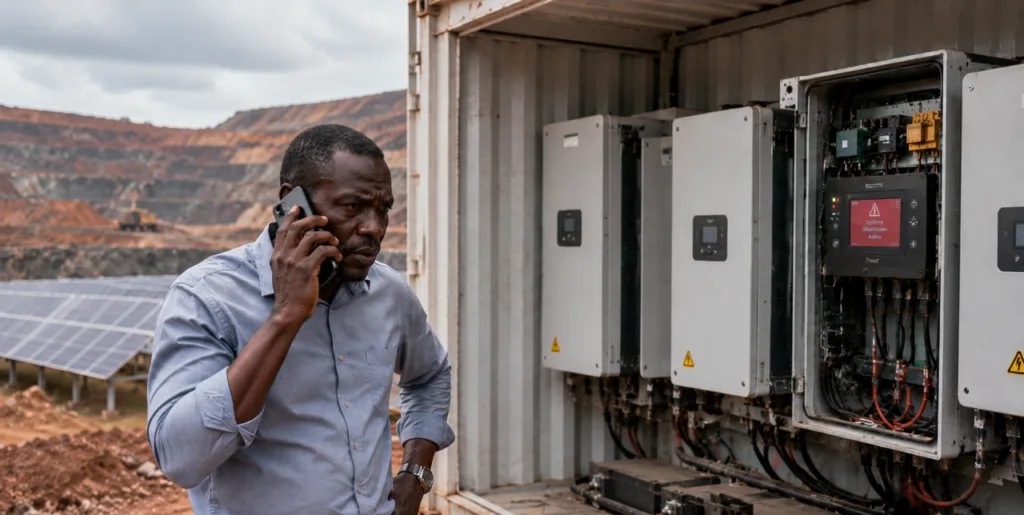
In the first half of 2026, cumulative solar PV installations at African mining operations are more than four times what they were in 2022. Chinese inverter exports to Africa grew 51% year-on-year between January and April. The Democratic Republic of Congo, Côte d’Ivoire, and other French-speaking markets are showing some of the strongest demand increases in the region.Multilingual customer support is often treated as a “nice-to-have” — until a single missed conversation turns into a lost opportunity.
The hardware is selling. The after-sales infrastructure hasn’t caught up.
When a piece of equipment fails at a mine site or a commercial installation in a French-speaking African country, the local distributor reports the fault — in French. That report needs to be received, understood, and acted on by someone who can capture the relevant technical information: the fault code, the operating environment, the equipment batch number, what the installer observed on site.
If the support team receiving that call only speaks English, none of that information gets collected accurately. The engineer who needs to be dispatched doesn’t have what they need. The fault stays unresolved. The penalty clause in the distribution contract gets triggered. And the distributor — who has options — starts looking at European or local competitors who can actually communicate with them.
This is where Chinese energy storage brands are losing African market position right now. Not on product quality. Not on price. On the support chain between the customer’s problem and its resolution.
What a French-speaking distributor actually needs when equipment fails
The support requirement for commercial and industrial energy storage equipment in French-speaking Africa is specific. It’s not translation assistance. It’s a complete dispatch coordination function operating in the right language.
When a fault is reported, the support team needs to receive the call in French and collect structured information — fault classification, operating conditions, site specifics, equipment identifiers — accurately enough to determine what kind of engineer needs to be dispatched and what they’ll need to bring.
Then an engineer needs to be matched and dispatched. Someone local, with the right technical competency for the fault type, accessible within a response window that doesn’t violate the distribution agreement.
The engineer’s progress needs to be tracked and communicated back to the distributor — in French — so the distributor knows where things stand without having to chase the information themselves.
After the repair, someone needs to follow up. Was the repair effective? Did the problem recur? Is the distributor satisfied with how the situation was handled? This conversation also happens in French.
And all of it — every ticket, every dispatch, every resolution, every satisfaction score — needs to flow back to the manufacturer’s headquarters in a structured format that the product, quality, and after-sales teams can actually analyze. Fault rate trends by region. Response time performance by engineer. Complaint categories by product line.
This is what a functional after-sales support structure looks like for this market. Most Chinese brands currently operating in French-speaking Africa have none of it. No local hotline. No bilingual team. No ticket system. The distributor manages their own problems as best they can, and the manufacturer has no visibility into what’s happening until a complaint arrives — or until the distribution relationship ends.
The language gap goes in both directions
It’s easy to focus on the inbound side of this problem — the distributor calling in French and finding no one who can understand them. But the outbound side is equally damaging.
When a support team sends technical guidance in English to a French-speaking distributor, that guidance often doesn’t get followed. Not because the distributor is uncooperative, but because technical instructions for electrical equipment — fault isolation steps, safety protocols, component specifications — need to be understood precisely to be executed safely. A mistranslation of a voltage specification or a wiring instruction isn’t just an inconvenience. In a mining or industrial context, it’s a safety issue.
The brands that are maintaining strong distribution relationships in French-speaking Africa are communicating in French. Full stop. Not through translation software. Not through English with an apology. In French, by someone for whom it’s a native language, who understands both the technical terminology for energy storage equipment and the commercial communication norms of West and Central African business relationships.
These are different skills from general bilingualism, and they need to be verified before someone goes into a client-facing role — not assumed because a candidate lists French as a language on their CV.
How Callnovo builds bilingual customer service for Africa energy storage brands

Callnovo’s approach to African energy storage support connects four components that individually exist in various forms but rarely get integrated into a functional whole for this market.
A bilingual team trained specifically for energy storage fault scenarios.
Agents are native-level in both English and French. Before handling any contacts, they go through specialized training on inverter and energy storage product terminology: fault code classification, standard information collection sequences for the equipment types they’ll be supporting, ticket system operation, and the commercial communication expectations of African distribution relationships.
The agents’ role is not deep fault diagnosis — that’s the engineer’s job. Their role is to collect the right information accurately and completely enough that the right engineer gets dispatched with everything they need. The quality of that first contact determines the efficiency of everything that follows.
A ticket system that tracks every dispatch from creation to close.
When a fault is reported, the agent creates a structured ticket in Callnovo’s platform. Dispatch assignment uses region, fault type, and engineer skill tags — automatically or manually depending on the complexity of the situation. Engineers receive and acknowledge assignments on their mobile devices, log arrival, and submit repair reports through the same system.
The agent tracks the ticket’s status and proactively updates the distributor in French at each stage. The distributor doesn’t have to ask where things stand. They receive updates before they need to.
Ticket traceability is not an optional feature for this type of support. In markets where distribution agreements carry penalty clauses for response time violations, the ticket record is the evidence base for resolving those disputes. Every timestamp, every status change, every communication — all of it logged.
Post-repair follow-up and structured data output.
After each repair is completed, the agent follows up with the distributor in French. Was the repair effective? Any recurring symptoms? Satisfaction with the response time and the engineer’s work?
All ticket data aggregates into monthly reports: fault rate trends by region and product line, operating environment distribution, response time performance, complaint categories. These reports go to the manufacturer’s product, quality, and after-sales teams — not as raw data dumps, but as structured analysis that can drive product improvement decisions and after-sales strategy adjustments.
When an equipment issue is generating disproportionate fault reports in a specific climate or operating environment, that pattern surfaces in the monthly data before it becomes a significant warranty liability.
A local 800 number printed on the equipment itself.
Callnovo assists brands in obtaining local African 800 numbers, connected to a North African French-language call center operating in the same time zone as the distributors calling in. The number goes on the equipment nameplate — not in documentation that gets separated from the device, but on the machine itself.
When a distributor or end customer has a problem, they call the number on the equipment. Someone in their time zone, speaking their language, answers. This is the baseline that most Chinese brands operating in French-speaking Africa currently don’t have — and it’s the difference between a support system that functions and one that exists on paper.
Coverage across both English and French-speaking African markets.
English-speaking markets — Nigeria, Ghana, Kenya — receive English-language support. French-speaking markets — DRC, Côte d’Ivoire, Senegal, Cameroon — receive bilingual English-French support. Additional languages including Portuguese for Mozambique and Angola, and Arabic for North African markets, can be layered in as distribution expands.
A single support infrastructure covers the linguistic complexity of the continent without requiring separate vendor relationships for each language region.
What this looks like as a competitive position
The African energy storage market is past the phase where price alone wins distribution relationships. Local distributors have options. They’ve seen enough equipment from enough suppliers to know that a good product with broken after-sales support is a worse deal than a slightly less optimized product with responsive, communicative service.
The brands building durable positions in this market are the ones whose distributors can actually reach someone when equipment fails. Someone who speaks French. Someone who creates a ticket and tracks it. Someone who calls back after the repair to confirm it worked.
Chinese manufacturers have a genuine advantage in hardware capability and price. The brands that are converting that advantage into lasting African market share are the ones adding a support infrastructure that matches the hardware quality — not leaving the distributor relationship to manage itself and hoping the product doesn’t fail.
The support gap in French-speaking Africa is real, it’s wide, and it’s currently being exploited by competitors who understood earlier that the market rewards whoever shows up — in the right language, with the right systems, in the right time zone — when something goes wrong.
Three questions worth asking about your current Africa support setup
- When a distributor in DRC or Côte d’Ivoire reports a fault, who receives that call and in what language? If the answer is “they email us in English,” you’re relying on your distributor to bridge a language gap that your support structure should be closing.
- How long does it take from fault report to engineer on site? If you don’t know the answer because you don’t have visibility into dispatch status in real time, your distributors definitely know — and they’re drawing conclusions about your reliability from that number.
- What does your fault data from African markets look like, and who acts on it? If the answer is that you find out about recurring issues when a distribution contract comes up for renewal, the data that should be driving product improvement is sitting in unstructured form in someone’s email inbox.
The hardware is competitive. The support infrastructure is the variable that determines whether the hardware advantage translates into market position — or gets eroded by distributors who switch to whoever actually supports them.
Expanding energy storage or industrial equipment distribution into African markets and thinking through after-sales infrastructure? Explore Callnovo’s multilingual support teams across Africa and HeroDash dispatch and ticket management platform, or talk to our team about what building this looks like for your markets and distributor network.