


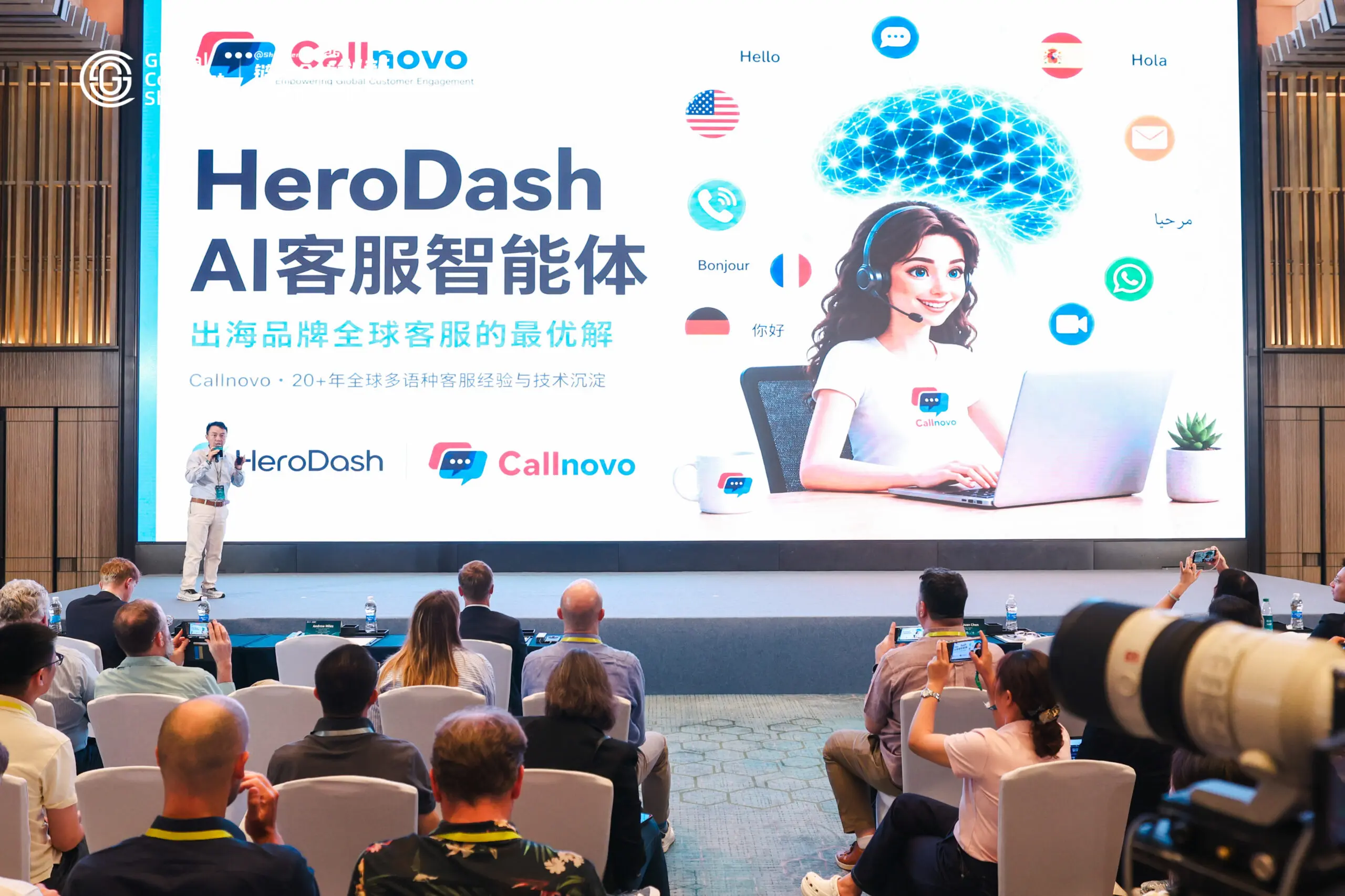
On June 1, 2026, Callnovo CEO Jackie Xu joined the Global Connect Show roundtable in Shenzhen — moderated by Yicai Global editor-in-chief Chen Juan — to discuss what actually breaks brand trust after a sale, and what the right global customer service architecture looks like in 2026.
The event
The Global Connect Show — organized by iMpact — brought together brand leaders, media partners, and ecosystem collaborators at the Zhongzhou Marriott Hotel in Shenzhen Nanshan on June 1, 2026. The event’s theme, “Linking Global Innovation, Gathering Business Opportunities,” positioned it as a forum for high-quality business connection rather than broad-scale expo-style exposure.
Attending brands included Dreame Technology, Lymow, Beatbot, Procolored, Keenon, Rokid Glasses, and Kiwi Innovation — companies spanning household and commercial robotics, digital printing, and AR smart eyewear. These categories represent exactly the kind of technically complex, internationally expanding hardware business where customer service after the sale determines whether early market traction becomes durable brand reputation.
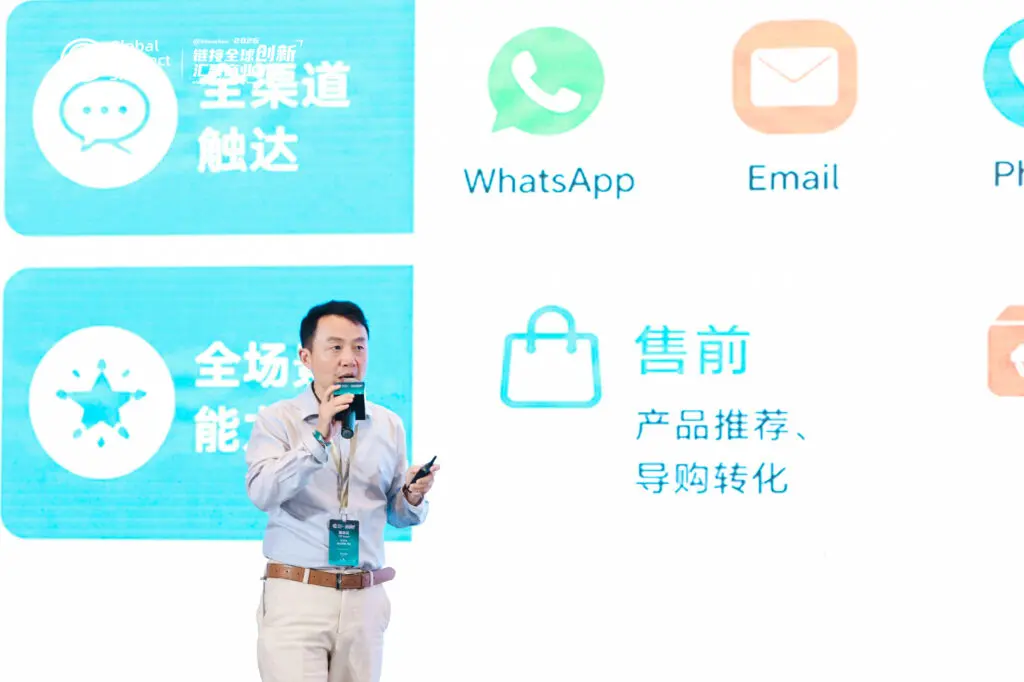
Callnovo CEO Jackie Xu participated in both the keynote session and the roundtable forum. What follows is an account of the roundtable conversation, including extended quotes from Jackie’s responses.
The opening question: where do brands lose the trust they’ve built?
Yicai Global editor-in-chief Chen Juan opened the roundtable with a question that cut to the core issue for any brand operating internationally: after all the investment in product quality, marketing, and market entry — where does the trust actually break down?
Jackie’s answer was direct and built from two decades of observing the same failure patterns repeat across different brands, different markets, and different product categories.
Jackie Xu, CEO, Callnovo
“From a customer service perspective, there are a few gaps that are very easy to fall into after a brand goes global.
First, customers can’t reach anyone after buying the product — the phone isn’t answered, or even if they get through, the follow-up doesn’t happen. This ‘can’t find anyone’ experience quickly erodes brand trust.
Second, they do reach someone, but the experience isn’t localized enough. If a product is sold in Europe or the US, but the customer service doesn’t match the local language, communication style, and cultural expectations — customers immediately sense something is off.
Third, they reach the right team, it feels local, but the problem still doesn’t get solved. This is the resolution rate problem. Customers contact a brand because they want their problem solved. If after a long conversation nothing gets resolved, that also erodes trust.”
Three gaps. Find the team. Feel the fit. Solve the problem. Jackie’s framing is simple enough to remember and specific enough to diagnose — and in the context of the brands in the room at GCS, every one of those gaps was recognizable.

Three actions every brand must take
Chen Juan followed with the practical question: if a brand wants to systematically improve overseas customer trust from the customer service side, what are the three things they absolutely have to do?
Jackie Xu, CEO, Callnovo
“Based on Callnovo’s experience over the past decade helping brands build global customer service systems, there are three core things.
First, build an omnichannel contact center in your target market. Customers might reach you through phone, email, online chat, WhatsApp, Twitter, in-app support, or social media. Brands need to make it easy for customers in any country, in any scenario, to find and contact them.
Second, the customer service system must be localized. Whether you’re building your own team or working with an external partner, serving customers in different countries means matching the local language, culture, and communication habits. Serving Spanish customers requires a service experience that fits the Spanish context and culture. The same applies to the US, Thailand, Italy, Germany. We achieve this now through an AI plus human dual-track model — AI that’s been locally calibrated, and human teams with native-level language ability and strong local service capability.
Third, the problem resolution rate has to be high. This requires systematic training of both AI and human agents — AI knowledge base calibration, human agent training, quality inspection, performance management, and service standard control. We reference COPC standards, and on some metrics we set targets higher than COPC requires. We also take seriously the privacy compliance requirements in each market — GDPR for European markets, for instance.”
The three-part framework — reachable, localized, effective — gives brands a diagnostic tool, not just a set of aspirations. Each element has a measurable analog: channel coverage, first-contact resolution rate by market, CSAT by language group.
One low-cost change with immediate impact
The most practically resonant moment in the roundtable came when Chen Juan pushed for a single actionable recommendation — something a brand could implement without increasing budget that would meaningfully improve overseas customer trust.
Jackie Xu, CEO, Callnovo
“Use AI as a co-pilot alongside your human agents.
When a human agent is responding to a customer, AI works alongside them in real time — prompting them on how to troubleshoot a problem, how to handle a refund process, how to manage an exchange. The AI cost is extremely low, but it dramatically improves the efficiency and accuracy of what human agents can deliver.
This is currently the highest return-on-investment way to improve customer trust.”
The co-pilot framing matters because it reframes the AI question. It’s not about replacing agents. It’s about making every agent significantly more effective in real time — reducing the gap between what an agent knows and what the customer needs without requiring months of additional training or a larger team.
What the worst overseas communication strategies look like
The roundtable took a sharper turn when Chen Juan asked each panelist to describe, in one sentence, the worst overseas brand communication strategy they’d encountered.
Jackie’s answer was grounded in a pattern he’s seen from the customer service side of brands across many categories:
Jackie Xu, CEO, Callnovo
“We’ve worked with many brands that have already sold large quantities of products overseas but have only a single contact method for customers — email. From our perspective, that’s not professional.
When customers encounter a problem and need help, they want to reach the brand immediately. Especially in Europe and North America, many customers prefer to call directly when they need assistance — they want an immediate response.
But some brands only offer email, and only start responding in batches after their team in China starts work in the morning. That’s a very poor service experience — and a very typical example of what not to do.”
Chris Dicker, CEO of Candr Media Group, added the marketing angle: brands that send outreach emails with recipients’ names spelled incorrectly, or that reference a competitor brand in a copy-paste template they forgot to update. “Getting someone’s name wrong is a serious error — it tells the customer you don’t actually know who they are.”
Jonathan Zhang of PartnerBoost highlighted the content control problem: brands that require influencers and content creators to follow scripts so rigidly that the content loses the authenticity that made the creator worth working with in the first place. “Consumers can feel when content is arranged. If it doesn’t sound like something the creator would actually say, it doesn’t convert.”

The HeroDash keynote: three numbers from a live deployment
Alongside the roundtable, Jackie presented in the keynote session on HeroDash — Callnovo’s proprietary AI customer service platform — with specific performance data from a deployment with a global top IoT brand, one of the world’s leading consumer camera manufacturers.
Three deployments, three sets of numbers:
Chat Agent — WiFi connectivity troubleshooting. Average resolution time: 3 minutes and 12 seconds. First-contact resolution rate: 92%. Customer satisfaction score: 4.8 out of 5. Cost per resolved interaction: $0.15 — compared to approximately $1.50 for a human agent handling the same contact.
Voice Agent — product installation guidance. Automatic language and product serial number identification, step-by-step guided assistance with real-time confirmation. Supports German, French, English, and additional languages. Cost per voice resolution: $0.45 — compared to $1.50 for human handling.
Returns and exchange end-to-end automation. The full flow — order verification, policy check, RMA creation, shipping label generation, customer notification — automated completely. Average processing time: 47 seconds. Automation rate: 100%.
Jackie’s framing of these numbers in the keynote was precise:
Jackie Xu, CEO, Callnovo — GCS Keynote
“The core of Callnovo’s hybrid model is not using AI to replace people. It’s letting multilingual human agents do what they’re actually best at — handling complex escalations, emotional conversations, strategic decisions. Our goal is: business grows three times, customer service costs grow only 0.2 times.”

What the room represented
The brands present at GCS — Dreame, Beatbot, Rokid, Keenon, and others — span categories that share a specific characteristic: technically complex products requiring substantive after-sales support, selling to demanding international consumers who have high expectations and ready access to alternatives.
For these brands, customer service is not a back-office cost to be minimized. It is the function that determines whether a product’s technical quality translates into lasting brand reputation in markets where the brand is new and trust has to be earned through every interaction.
The conversation at GCS reinforced a point that Callnovo has been making through actual deployments for two decades: the gap between a brand that succeeds internationally and one that struggles is often not the product. It’s whether customers can reach them, whether the service feels like it belongs in the market, and whether the problem actually gets solved.
Those three conditions — reachable, local, effective — are what Jackie described at the roundtable. They’re also what HeroDash was built to deliver.

Interested in how Callnovo and HeroDash support global brands across 65+ languages and 35+ operations centers? Visit callnovo.com to learn more, or contact our team directly to discuss what the right customer service setup looks like for your markets.